With the improvement of people’s living standards and increased awareness of skin care, hand cream has become an indispensable part of daily care products. The global hand cream market continues to expand as consumers increasingly seek moisturizing, repairing and premium skincare products. This growth is mainly attributed to the rise in consumer demand for hand care, especially in the post epidemic era, where frequent use of sanitizers has led to an increase in the number of hand skin problems, which has further propelled the development of the hand cream market. As a professional hand cream manufacturer, this guide explains how a professional hand cream manufacturer supports private label brands—from formulation development to production, packaging and commercial launch.
Hand cream sits within the broader personal care manufacturing system, sharing the same emulsification lines and quality procedures as body lotion production.
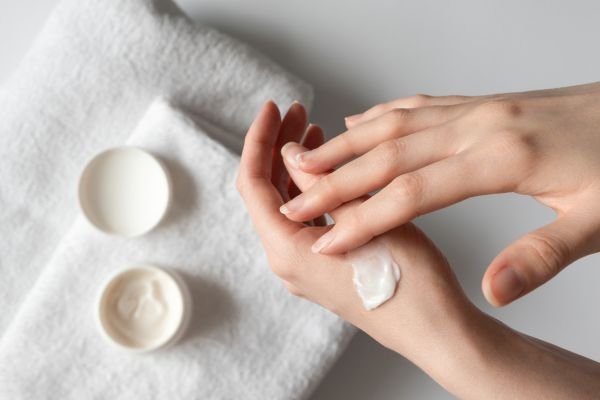
The hand cream market is currently showing a diversified development trend, with a complete product hierarchy ranging from mass affordable products to high-end luxury brands. Among them, the demand for natural and organic hand creams and functional care products has increased significantly. Consumers are increasingly concerned about the safety and efficacy of product ingredients, which prompts manufacturers to continuously improve the formula and develop products that better meet market demand.
Hand cream formulations and production processes
Moisturizers play a crucial role in the base formulation. glycerin and hyaluronic acid are the most common moisturizing ingredients, which can effectively lock in moisture and provide a long-lasting feeling of wetness to the skin. Oil bases such as sesame, almond and coconut oils are responsible for forming a protective film on the skin, minimizing moisture loss and giving hand creams a silky texture. These oils not only moisturize the skin but also provide essential nutrients.
Special ingredients
Some hand creams are also formulated with special ingredients, such as Retinol, which is a star product in the high-end skincare market and has a more complex and refined formula. Retinol, a derivative of vitamin A, has significant anti-aging and restorative properties. Retinol hand cream manufacturer often adds higher concentrations of antioxidants such as Vitamin E and ceramides to combat free radicals, improve skin texture, and minimize the appearance of fine lines and discoloration. The production of this type of hand cream requires strict temperature control and a precise proportioning process.
Private Label Hand Cream Product Positioning
Successful hand cream brands are built around clear market positioning rather than a single formula. Before product development begins, a professional hand cream manufacturer will usually help brands define the target consumer and product claims.
Common private label positioning includes:
- Daily Moisturizing – Lightweight formulas for everyday hydration and fast absorption.
- Repair & Intensive Care – Rich creams designed for dry, cracked or damaged hands.
- Sensitive Skin – Gentle formulations free from harsh ingredients, suitable for frequent use.
- Natural & Botanical – Plant-based ingredients with clean-label positioning.
- Premium Anti-Aging – Advanced formulations featuring peptides, ceramides or retinol alternatives.
- Travel & Gift Collections – Compact packaging designed for retail, promotional or seasonal programs.
Choosing the right positioning early allows manufacturers to recommend suitable ingredients, packaging formats and production solutions while reducing unnecessary development time.
Production process
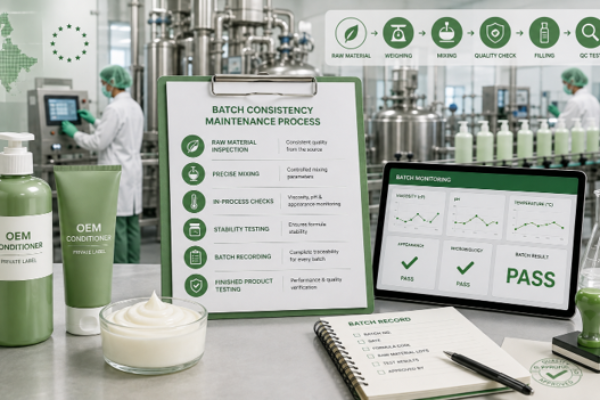
The production process of hand cream is a precise craft. The first step is the fine screening and proportioning of raw materials, where different ingredients need to be precisely mixed at specific temperatures. Emulsification is the key step, requiring a high-speed shear emulsifier to evenly mix the oily and water-based ingredients. This is followed by homogenization to ensure even distribution and fine texture. The final stage of filling and sealing is equally rigorous, with each batch requiring stringent microbiological and stability testing. From laboratory formulation to mass production, each step reflects the exquisite craftsmanship of modern cosmetic technology.
As an important part of personal care products, the formulation and production process of hand cream reflects the essence of modern cosmetic technology. The basic formulation of a hand cream usually consists of a number of key ingredients: a moisture provider, a humectant, an oil base, an active ingredient and a preservative. Moisture is the foundation of the hand cream, usually occupying 50-70% of the formulation, and is responsible for providing the initial moisturization and delivering the other active ingredients.
How to Choose the Right Hand Cream Manufacturer
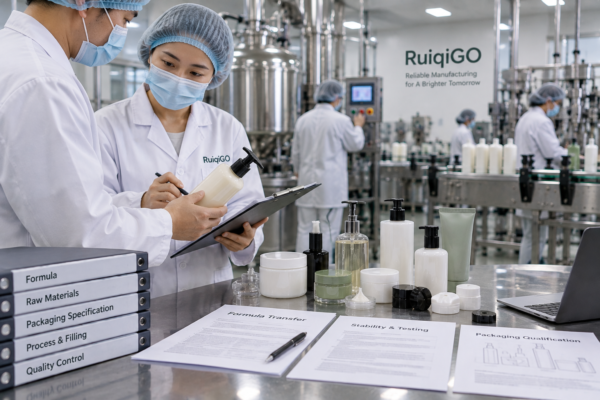
Selecting the right hand cream manufacturer is one of the most important decisions when launching a private label skincare brand. Beyond production capability, the ideal OEM partner should support formulation development, quality assurance, packaging customization and long-term product growth.
When evaluating potential manufacturers, consider the following factors:
- Formulation Expertise – Can the manufacturer provide both ready-to-market formulas and customized product development based on your brand positioning?
- Quality Management – Look for manufacturers with established quality control systems, stability testing procedures and internationally recognized certifications.
- Production Capacity – Ensure the factory can meet your expected order volumes while maintaining consistent product quality and reliable lead times.
- Packaging Support – A strong manufacturing partner should assist with tube or bottle selection, artwork compatibility and retail packaging solutions.
- Export Experience – If your products will be sold internationally, choose a manufacturer familiar with export documentation, labeling requirements and market compliance.
Rather than selecting a supplier based on price alone, brands should focus on long-term manufacturing capability, communication efficiency and product consistency. A reliable hand cream manufacturer becomes a strategic partner that supports both product development and future business growth.
The key steps to create private label hand cream
Creating a successful hand cream brand requires systematic planning and execution. First of all, we need to conduct adequate market research, define the target consumer groups and market positioning, and develop a differentiated product strategy. At the initial stage of brand building, a lot of resources need to be invested in product research and development, including choosing the right formulation R&D team, determining the product range planning, conducting formulation testing and effect verification, and paying attention to applying for relevant patents and certifications. The choice of hand cream manufacturer is also crucial, and it is necessary to examine its production qualifications, scale, quality control system and R&D capabilities and other aspects. In addition, packaging design as an important carrier of the brand’s visual identity, the need to find a balance between functionality and aesthetics, while also taking into account environmental factors.
Hand Cream Manufacturer Selection
In personal care branding, choosing the right hand cream manufacturer is a critical part of ensuring the success of your product. A good manufacturer not only provides processing services, but is an important partner in the strategic development of the brand. The selection process requires a thorough evaluation of several dimensions, none of which is essential.
Technology development capability
Technology development capability is the first and foremost criterion. An excellent hand cream manufacturer should have an advanced formulation research and development team, able to quickly adjust the product formula according to market demand. They should have specialized cosmetic researchers who are familiar with the latest skincare technologies and active ingredients. For example, a manufacturer that can quickly integrate cutting-edge skincare ingredients such as retinol and ceramides will provide the brand with a greater competitive advantage in the market.
Production qualifications and quality control systems
Production qualifications and quality control systems are the second key consideration. A good manufacturer must have both an international cosmetic production license (e.g., ISO 22716 certification) and relevant qualifications from the Food and Drug Administration. The quality control capability during the production process is reflected at several levels: raw material control, production environment, microbiological testing, stability testing, etc. A manufacturer that can provide full-process quality traceability will greatly reduce product risk.
Production scale and flexible manufacturing capability
Production scale and flexible manufacturing capability are important factors that cannot be ignored. Brands need to assess the manufacturer’s capacity matching, including minimum order quantity, production cycle, rapid response capability, etc. Excellent manufacturers should have flexible production lines that can quickly respond to changes in market demand and support a flexible production model with small lot sizes and multiple varieties. At the same time, stronger scale production capacity can also help reduce production costs.
Balancing cost and innovation
Balancing cost and innovation is the art of choosing a manufacturer. Simply pursuing low cost is not desirable, but rather finding a balance between cost control and innovation capability. An excellent manufacturer should be able to provide cost-effective production solutions and provide value-added services in terms of formulation innovation and packaging design. For example, a producer that can offer services such as personalized packaging customization and small batch trial production will provide brands with greater flexibility in the market.
Questions to Ask a Hand Cream Manufacturer
Before selecting an OEM partner, brands should evaluate more than pricing. Asking the right questions early helps reduce project risks and shortens development timelines.
- What is your minimum order quantity (MOQ) for private label hand cream?
- Do you offer both stock formulations and custom formula development?
- What testing is performed before mass production?
- Can you support custom packaging, labeling and artwork?
- What are your typical production and delivery lead times?
A qualified manufacturer should provide clear answers covering formulation capability, quality control, production capacity and export experience before a project begins.
Finally, there is a need to comprehensively assess the producer’s industry reputation and long-term stability. It is recommended that background checks be conducted through multiple channels: industry exchanges, recommendations from other brands, site visits, and so on. A producer with a good reputation and stable operation will become a reliable partner for the long-term development of the brand. Comprehensively consider the technical strength, qualification, scale, cost and reputation, in order to find a truly matching hand cream manufacturer.
Private Label Hand Cream Development Process
Developing a successful private label hand cream follows a structured process that balances product performance, regulatory compliance and manufacturing efficiency.
Step 1 – Product Brief
Define the target market, positioning, packaging format, fragrance preference and product claims.
Step 2 – Formula Development
Select either an existing OEM formulation or develop a customized formula based on your brand requirements.
Step 3 – Sample Evaluation
Evaluate texture, absorption, fragrance, appearance and overall user experience before approving production.
Step 4 – Packaging Development
Confirm tube or bottle selection, artwork, printing specifications and shipping carton design.
Step 5 – Stability & Quality Testing
Samples undergo stability evaluation and quality verification to ensure production consistency.
Step 6 – Mass Production
Once all specifications are approved, production begins under standardized quality control procedures before final inspection and shipment.
Following a structured development process helps reduce delays, improve communication and bring products to market more efficiently.
The precautions for creating a hand cream brand
Launching a private label hand cream involves more than selecting a formula. Brands should also consider regulatory compliance, packaging compatibility, quality assurance and long-term manufacturing capability. Working with an experienced hand cream manufacturer helps reduce development risks and ensures a smoother transition from concept to commercial production.
If you are also comparing adjacent product categories, our guide to body lotion manufacturing explains how lotion formulations and production differ from hand cream development.
Ready to Launch Your Private Label Hand Cream?
Whether you’re developing a moisturizing, repairing or premium hand cream, choosing an experienced OEM manufacturer helps shorten development time and improve product consistency.
👉 Explore our Personal Care Manufacturing solutions →
FAQ
What is the MOQ for private label hand cream?
MOQ depends on packaging format and formulation. Most OEM projects begin at 3000 units per SKU.
Can I customize the hand cream formula?
Yes. Most manufacturers offer both stock formulations and fully customized OEM development based on your target market and positioning.
What should I evaluate before choosing a hand cream manufacturer?
Review formulation capability, quality certifications, production capacity, packaging support and experience with international compliance.