The sample you approved was great, but will the commercial batch actually match it?
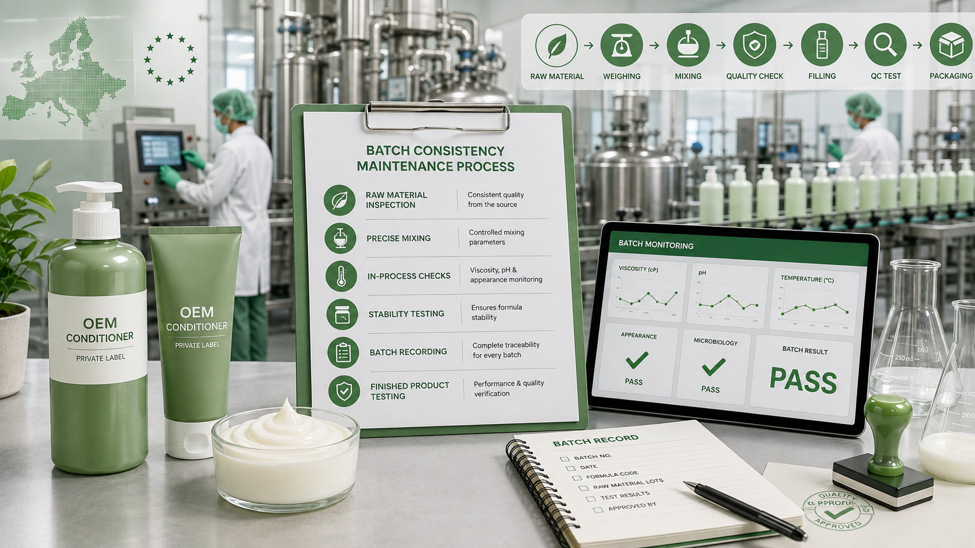
For private-label conditioner production, getting the formula right is only part of the job. Manufacturers must also control raw material preparation, batch processing, quality checks, and comparison with the approved reference.
Commercial batch consistency depends on controlling the materials entering production, following defined batch-processing procedures, checking the product during and after production, and verifying that the commercial process can reproduce the approved product at scale.
In this guide, we’ll walk through the commercial conditioner manufacturing process, from raw material preparation to finished-product release. We’ll explain why each stage matters when evaluating whether a manufacturer can reproduce your product consistently at commercial scale.
The exact production steps can vary slightly depending on the approved formulation, so the workflow below should be understood as a representative commercial manufacturing process rather than a fixed SOP.
Why the Manufacturing Process Matters in OEM Conditioner Production
A conditioner formula can look right on paper and still produce inconsistent results if the manufacturing process is not properly controlled. The same approved formula needs to produce the same appearance, texture, and key quality characteristics from one batch to the next.
That makes the manufacturing process an important part of evaluating a partner. A capable OEM hair conditioner manufacturer should have defined production steps, quality checkpoints, and release controls that help identify variation before it moves further through production.
For buyers, the question is not simply whether a manufacturer can make one successful sample. It is whether the manufacturer has a controlled process for reproducing that product reliably at commercial scale.
Raw Material Inspection and Production Preparation
A consistent conditioner batch starts with the materials entering production. Before manufacturing begins, raw materials are received, inspected, and prepared according to the requirements of the production batch.
The materials must correspond with the approved product requirements because variation at this stage can affect the consistency of the finished conditioner. The factory also maintains records that connect the raw-material lots used in production with the finished batch. If a quality issue arises later, these records provide a starting point for determining whether the materials contributed to the deviation.
For buyers, this means quality control begins before the conditioner reaches the mixing stage. A manufacturer needs a controlled, traceable set of materials before production can begin consistently.
Formula Preparation and Batch Weighing
Once the raw materials have been received and prepared, the next step is to translate the approved formula into the actual production batch. This involves preparing and weighing the required materials according to the production requirements for that batch.
Accurate weighing is important because even when the same raw materials are used, differences in the amount added can affect the final conditioner. The production team therefore needs to work from the defined formulation and maintain the relevant weighing and dispensing records.
This stage also creates a traceable record of what went into a particular batch. If the finished product later shows a deviation, those records can help the factory review whether the correct materials were used and whether the batch was prepared as required.
For a buyer evaluating a manufacturer, this is one of the less visible parts of the conditioner manufacturing process, but it matters because consistent production starts with consistent preparation.
Mixing and Emulsion Formation
Once the materials have been prepared and weighed, they are processed and combined to create the conditioner. The different components need to form a smooth, uniform mixture that delivers the intended texture, appearance, and stability of the finished product.
Emulsification brings components that do not naturally remain mixed into a stable system. During the conditioner manufacturing process, controlled processing helps distribute these components evenly throughout the batch. If the process is not properly controlled, the finished conditioner can show differences in texture, appearance, or stability.
The exact processing sequence depends on the approved formulation, so there is no single set of temperatures, mixing speeds, or ingredient adding steps that applies to every process. The manufacturer instead follows the defined requirements for the specific formula and monitors the batch as it develops.
For an OEM buyer, the key consideration is whether a manufacturer can consistently translate the approved formula into the intended finished product at commercial scale.
Process Control and Viscosity Management
Once the conditioner is being processed, the batch is monitored rather than left until the end for a single quality check. Operators check relevant characteristics throughout production to confirm that the batch continues to develop within the required specifications.
Depending on the formulation, routine in-process checks can include:
- Appearance: The batch is checked for visible changes that could indicate an issue with how the product is developing.
- Colour: The colour is compared with the expected product appearance to identify unwanted variation during production.
- Odour: The batch is checked for unusual or unexpected odour that could indicate a material or processing issue.
- pH: The pH is measured to confirm that it remains within the required specification for the product.
- Viscosity: The thickness or flow of the conditioner is checked to ensure it remains consistent with the approved product requirements.
- Uniformity: The batch is assessed to confirm that the product remains evenly mixed rather than showing signs of uneven distribution.
- Temperature: Temperature is monitored because processing conditions can affect how the formulation develops.
These checks allow the production team to identify deviations while the batch is still being processed. The semi-finished or bulk product is then checked and released by QC before moving to the next stage.
This gives a manufacturer a structured way to keep production aligned with the approved product rather than relying solely on final inspection.
Final Quality Control Before Filling and Packaging
Once the bulk conditioner has completed production, it undergoes final quality checks before filling and packaging begin. At this point, the factory needs to confirm that the finished batch corresponds with the product that was approved for commercial production.
The initial filled sample is checked against the approved reference sample, while the batch number is verified against the production order. This helps confirm that the correct batch is being evaluated against the right product requirements.
Finished-product release is conducted against the individual product specification and includes:
- Sensory evaluation: The finished conditioner is assessed for characteristics such as appearance and odour.
- Physicochemical testing: Relevant properties, such as pH and viscosity, are checked against the applicable specification.
- Microbiological testing: The product is tested to verify that it meets the required microbiological specifications.
Additional testing may be required depending on the customer or destination market. Where heavy-metal or other risk-substance testing is required, this can be handled through a third-party laboratory rather than treated as routine in-house testing for every project.
For a private label manufacturer, this release stage provides a final quality gate before the approved bulk product moves into filling.
Filling, Packaging and Finished Product Preparation
After the bulk conditioner passes final quality control, it moves into filling and packaging. The approved product is transferred into the selected containers, followed by the required labeling, coding, and packaging steps.
The packaging process also provides another point for maintaining product traceability. Batch information needs to remain associated with the finished goods so the packaged products can be linked back to their corresponding production records.
At this stage, the focus is no longer on developing the conditioner itself. The priority is to ensure the approved bulk product is filled and prepared correctly as a finished product ready for storage and shipment.
Finished Goods QC and Batch Documentation
Once the finished conditioner has been filled and packaged, the batch remains traceable through its finished-goods batch number. This allows the factory to connect the packaged product with the records created throughout production.
The batch number can be traced back to information such as:
- Production date
- Raw-material lot
- Supplier batch
- Weighing and dispensing records
- Production records
- QC records
- Filling records
- Related batch documentation
This traceability gives the factory a structured record to work from if a quality question arises after production. For example, the relevant batch records can be reviewed to identify the materials used, how the batch was produced, and what quality checks were completed.
For buyers working with a production partner, traceability provides an additional layer of accountability across the production process. It does not mean every internal record is automatically provided to the customer; rather, it means the factory can trace a finished batch back through its production history.
Scaling From Sample Approval to Commercial Production
An approved laboratory sample is not the same as a commercial production batch. Once the customer approves the formula, RuiqiGO performs another small-scale trial before formal production.
In most cases, this is sufficient to confirm that the formula can be reproduced as expected. Pilot production is used only for certain products that need to meet specific targets, so it is not a standard step for every conditioner project.
During scale-up, the relevant product characteristics are reconfirmed against the approved sample and applicable specifications. These include:
- Odour: The commercial batch should remain consistent with the approved sample.
- Appearance: The finished product should maintain the expected visual characteristics.
- pH: The measured value should remain within the applicable specification.
- Viscosity: The product’s thickness should remain within the required range.
- Microbiological quality: Results are checked against the applicable microbiological specification.
Stability is considered separately according to the relevant product and project requirements. It should not be understood as a full long-term stability study being repeated as a routine release test for every commercial batch.
If a commercial batch deviates from the approved requirements, the investigation follows a defined sequence. The factory first confirms that the correct raw materials were used, then checks whether the production steps followed the required process.
Relevant indicators are subsequently sampled and analysed against the specification to help identify the source of the deviation.
For a buyer evaluating an OEM supplier, this is the part of scale-up that deserves particular attention.
The manufacturer needs a process for checking that the commercial batch remains consistent with what was actually approved, rather than assuming that a successful laboratory sample will automatically translate to production.
The scope of this scale-up work can also influence what is included in an OEM quotation, particularly when development or production requirements extend beyond a standard project.
Common Manufacturing Problems and What They Usually Indicate
A commercial conditioner batch can sometimes show differences from the approved product. When that happens, the manufacturer needs to determine whether the variation is related to the raw materials, processing, or another factor affecting the batch.
| Problem | Possible Causes | What the Factory Checks |
| Product separation | Incomplete dissolution, material clumping, insufficient heating or stirring, or cooling too quickly and destabilizing the emulsion system. | Whether the correct materials were used, the defined process was followed, and the relevant materials were fully dissolved. |
| Inconsistent viscosity | pH variation, uneven dissolution, insufficient heating or stirring, temperature sensitivity, or raw-material batch variation. | The relevant product indicators are sampled and analysed against the applicable specification. |
| Colour variation | Differences in raw-material colour or batch, temperature, heating time, colourant addition, oxidation, or light exposure. | The affected batch and relevant production records are reviewed to identify potential sources of variation. |
| Fragrance variation | Fragrance batch differences, addition temperature or timing, volatility, raw-material odour, or formulation interactions. | The fragrance, addition amount, and relevant processing conditions are reviewed. |
These are not automatic diagnoses. The same visible problem can have more than one possible cause, which is why the factory investigates the relevant material and process factors before determining what happened.
This structured approach helps the factory turn an unexpected variation into something that can be investigated rather than simply treated as a failed batch.
Frequently Asked Questions
How is conditioner manufactured in a commercial factory?
Commercial conditioner production typically involves raw material inspection and preparation, batch weighing, controlled mixing and emulsification, in-process quality checks, final QC, filling, and finished-goods preparation. The exact sequence and processing conditions can vary depending on the approved formulation.
How do manufacturers maintain conditioner consistency at commercial scale?
Manufacturers use controlled production steps and quality checkpoints throughout the batch. After sample approval, the formula is also checked through a small-scale trial before formal production, while key characteristics such as appearance, odour, pH, viscosity, and microbiological quality are reconfirmed against the applicable requirements. Stability requirements are considered separately according to the product and project.
What quality checks are performed during conditioner production?
Checks run throughout production rather than only at the end, covering appearance, colour, odour, pH, viscosity, uniformity, and temperature as the batch develops. The finished product then goes through a separate release stage involving sensory, physicochemical, and microbiological testing.
What happens if a commercial conditioner batch does not match the approved sample?
The factory investigates the deviation by checking whether the correct raw materials were used, whether the defined production process was followed, and whether relevant product indicators remain within specification. The investigation helps identify the likely source of the variation before deciding on the appropriate response.
Why is batch traceability important in conditioner manufacturing?
Batch traceability allows the factory to connect finished products with their production history, including raw-material lots, weighing records, production records, QC records, and filling records. This gives the manufacturer a structured basis for investigating quality questions that arise after production.
Start Your Conditioner Project with RuiqiGO
A consistent conditioner doesn’t happen simply because the right formula was approved. Before choosing an OEM manufacturer, buyers should look at whether the manufacturer has a controlled process for reproducing that approved product at commercial scale.
Before choosing a manufacturer, ask:
- How are raw materials and production batches traced? Ask what batch information or documentation can be shared with customers.
- How is the approved formula controlled during production? Ask how key stages such as weighing, mixing, and emulsification are managed.
- Which quality characteristics are checked? Ask about relevant checks such as appearance, colour, odour, pH, viscosity, and microbiological quality.
- How is commercial production compared with the approved sample? Ask which characteristics are reconfirmed during scale-up and finished-product release.
- What happens when a batch deviates from specification? Ask how the manufacturer investigates the cause and determines the appropriate response.
- What QC or batch records can be shared? This helps you understand what evidence of production and quality control will be available to you.
RuiqiGO applies these controls from sample development through commercial production, helping brands build a controlled and repeatable manufacturing process around their approved conditioner formula.
Ready to develop a conditioner with a production process designed for reliable batch consistency?
Contact the RuiqiGO manufacturing team to discuss your product requirements, formulation direction, and commercial production needs.