If you try to compete on price alone against mass-market conglomerates with massive retail networks, you will lose.
Instead, your production success comes down to a smart formulation strategy that balances ingredient familiarity with factory-floor realities. Using widely recognized ingredients means easier discussions with retailers.
When regional distributors and retail buyers see familiar names like ceramides or oat extract on your spec sheet, they instantly get the product’s value. You don’t have to explain it to them.
This guide breaks down exactly how your choice of ingredients dictates your manufacturing costs, minimum order quantities (MOQs), sourcing complexity, and production timelines.
How Ingredient Choices Affect Cost, MOQ, and Product Claims
What goes into the mixing tank changes the hard economics of your entire production run. You have to align your product goals with actual factory capabilities before you place a purchase order.
Four distinct operational factors will impact your upfront budget and your pipeline timeline:
Commodity Ingredients
Standard humectants like glycerin and base surfactants like sodium laureth sulfate are commodity ingredients with highly stable pricing and wide availability.
hey are incredibly easy to process, don’t require specialized handling in the factory, and keep your baseline cost per unit low. Relying on these staples ensures predictable production and consistent batches every single time.
Premium Active Ingredients
On the flip side, premium actives like pure ceramides, peptides, or liposomes require a lot of extra care on the production floor.
These materials often need controlled environments, like nitrogen blanketing to prevent oxidation, or strict temperature monitoring during hot-blend processing to keep them stable. This extra processing time adds up and pushes your manufacturing costs higher.
MOQ Impact
If you specify a rare botanical extract or a niche functional chemical that your manufacturer doesn’t normally stock, they have to buy it from a specialty vendor.
Because those chemical suppliers enforce their own minimum order quantities, you have to absorb the cost of any leftover material if their minimum purchase is bigger than your batch needs. This can dramatically spike your upfront capital commitment.
Lead Time Impact
Sourcing niche or international ingredients introduces serious supply chain volatility. While commodity items are usually sitting in the warehouse ready to go, specialty actives can add weeks to your timeline due to customs clearance, freight bottlenecks, and supplier backlogs.
If you have strict delivery deadlines, you have to weigh formulation complexity against realistic lead times.
Which Body Wash Ingredients Are Trending in 2026?
The skinification trend has changed what we run through our production lines. Consumers now expect the same high-performance ingredients in their shower gel that they use in premium face serums.
To meet this demand without letting your manufacturing costs spiral, you need to optimize your active dosing levels. Incorporating these high-demand components into your private label body wash lineup comes with specific sourcing and formulation realities.
Here are ingredients you want to look out for in 2026:
- Ceramides: Crucial for lipid barrier protection. They are highly sought after for dry skin lines, but they require precise stabilization during emulsification so the batch doesn’t separate on the shelf.
- Oat Extract: This includes beta-glucan and avenanthramides from colloidal oatmeal. It is an industry standard for reducing skin irritation, blends beautifully in the tank, and has a highly reliable supply chain.
- Niacinamide: This vitamin B3 derivative targets rough texture and skin tone. It is highly water-soluble, meaning compounding teams can easily integrate it into standard liquid bases without slowing down the batch cycle time.
- Hyaluronic Acid: Famous for deep hydration. It transforms a basic surfactant blend into a premium product, though we have to monitor viscosity closely to ensure it doesn’t slow down the filling lines.
Using these familiar ingredients keeps your formulation simple and avoids adding technical manufacturing risks.
Managing Sourcing Complexity for High-Volume SKUs
Not every product in your lineup needs a complex clinical active. For high-volume retail and mass-market channels, your safest, most reliable starting point is a flagship formula built around moisturizing ingredients that have a proven track record on the factory floor.
Starting with a shea butter or glycerin-based formulation offers a lower sourcing risk because these hydrating bases have stable raw material costs and widespread availability. They ensure more predictable production.
Once your baseline production volume is steady, adding a ceramide or hyaluronic acid line is a natural way to transition into a higher-tier formula. This allows you to target specialized segments with a clear manufacturing cost impact. While the formulation complexity increases, your production yield rises significantly.
To make this move smoothly, you have to consider sourcing realities. Working with an experienced manufacturer to use proven, pre-stabilized ingredient systems cuts your initial R&D costs and eliminates the risk of a batch breaking down when we scale it up to full production.
If you are building your flagship line around intensive hydration, partnering with a dedicated body wash for dry skin manufacturer lets you access base formulas that have already cleared stability testing. This keeps your initial production predictable and significantly speeds up your launch timeline.
Formulating Cost-Effective Solutions for Sensitive Skin
The sensitive skin segment rewards formulation consistency, minimal ingredient decks, and strict manufacturing discipline. Developing an oat extract body wash is the most operationally efficient entry point here, as colloidal oatmeal maintains stable pricing and straightforward processing requirements.
One of the best ways to maximize your capital efficiency is a strategy we call the single base, two SKU split. The factory runs one large, high-quality body wash base, and then splits that batch on the filling line to create two distinct products:
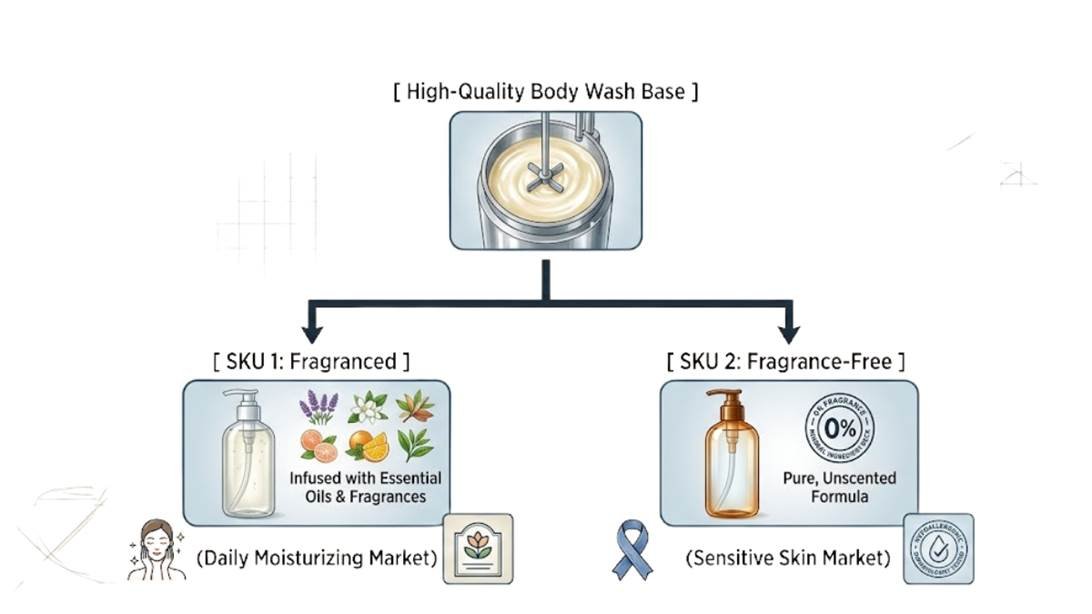
With this method, your brand gets two distinct products on the shelf without you paying double for custom formulation development or incurring two separate factory setup fees.
The fragrance-free option also solves a massive operational headache because fragrance compounds are the number one cause of batch instability and consumer skin reactions. Offering a clean, minimal ingredient deck helps you pass regulatory reviews and secure shelf space with discerning buyers much faster.
When you are ready to scale, working with an experienced sensitive-skin body wash manufacturer who actually understands raw material purity makes the difference between a product that is simply labeled gentle and one that can pass stability testing and support verified dermatologist-tested claims.
Balancing Natural and Clean Label Demands in OEM Production
Running eco-friendly or clean-label production means balancing formulation requirements with three specific operational realities on the shop floor:
- Sourcing Complexity: For consumers, natural means plant-derived. For the factory, manufacturing a clean-label body wash means sourcing certified raw materials, maintaining audited chain-of-custody paperwork for every batch, and ensuring compliance with international cosmetic standards.
- The Formulation Balancing Act: Plant-based preservation systems are often less forgiving than conventional options. Natural extracts can introduce color or odor shifts from batch to batch, and mild surfactants can alter the rich, foaming lather that consumers expect.
- Risk Mitigation: Formulations must avoid unstable chemical combinations that could cause lead-time considerations or fail international compliance. Your formulation strategy should remain focused on raw material quality, stability testing, and manufacturing reliability.
Choosing a manufacturing partner with a proven track record in clean formulations will help you navigate these trade-offs without compromising your product’s shelf life.
Which Ingredients Commonly Raise Consumer Concerns?
Certain legacy ingredients require an early conversation with your contract manufacturer. While these components are safe at standard regulatory levels, their presence on your label can create friction with major retail chains and make your supply chain vulnerable.
To ensure long-term market compliance, modern brands are actively transitioning away from these flagged compounds:
- Sulfates: Sodium lauryl sulfate and sodium laureth sulfate are the most heavily scrutinized cleansing agents in personal care because buyers associate them with skin dryness and irritation.
- Parabens: Chemical preservatives such as methylparaben and propylparaben face widespread skepticism in the US natural beauty segment due to long-term health debates.
- Formaldehyde Releasers: Ingredients such as DMDM hydantoin and imidazolidinyl urea are increasingly flagged by consumers because they slowly release small amounts of chemicals to preserve the product.
- Isothiazolinones: Preservatives like methylisothiazolinone are known to be strong skin sensitizers and frequently trigger contact allergy complaints in rinse-off products.
- Phthalates: Often found within complex traditional fragrance mixtures, these compounds face heavy scrutiny from clean beauty advocates who demand full ingredient transparency.
- Triclosan: This legacy antibacterial agent has faced severe regulatory restrictions and negative press, making it a major red flag for modern shoppers.
The production fix is to work with your factory to select mild, plant-derived alternatives.
For instance, coco glucoside, a natural surfactant made from coconut oil and fruit sugars, produces a fine, stable foam and pairs with secondary surfactants to maintain excellent viscosity and cleaning characteristics.
Production Matrix: Matching Ingredients to Product Types
To finalize your product development strategy, use this formulation framework to align your ingredient choices with production realities. This matrix maps out how each product tier impacts your manufacturing costs, MOQs, and regulatory claims.
| Product Tier | Core Active Ingredients | Distribution Type | Cost and MOQ Impact | Key Pack Claims |
| Daily Hydration | Shea Butter, Glycerin, Coco-Glucoside | Mass Market and High-Volume Retail | Low raw material cost and standard minimum factory MOQs | Deeply Hydrating, Daily Skin Nourishment |
| Advanced Clinical | Ceramides, Oat Extract, Niacinamide | Dermatological Niche and Premium Retail | Moderate to High cost and requires verified active dosing | Barrier Repair, Soothes Irritation, Fragrance-Free |
| Clean Botanical | Plant-Derived Preservatives, Hyaluronic Acid | Eco-Conscious and Clean Beauty Prestige | Higher raw material cost and strict raw material certification tracking | 100% Vegan, Plant-Based Lather, Clean Label |
Rather than starting with the most complex formula, many successful private label brands launch with a scalable base formulation and expand into premium ingredient systems after validating market demand.
Planning Your Private Label Body Wash Formula?
Choosing the right ingredient system is only one part of a successful launch. Manufacturing capability, production scale, and formulation stability all affect your final product quality.
Explore our Body Wash Manufacturing solutions to learn how RuiqiGO supports custom formulation, private label production, and OEM manufacturing for global brands.
Frequently Asked Questions About Private Label Body Wash Ingredients
Can I use the same body wash formula for both sensitive skin and moisturizing product lines?
Yes, with minor modification. A single base can be split into two separate SKUs by adjusting the fragrance, active concentrations, and packaging labels. This is one of the most cost-effective ways to launch two distinct lines without paying for duplicate formulation development cycles.
What ingredients are most used in private-label body wash?
The standard backbone of private label body wash production includes primary surfactants for cleansing (like sodium laureth sulfate or plant-derived ammonium lauryl sulfate), co-surfactants to improve mildness and lather (typically cocamidopropyl betaine), and standard humectants for moisturizing (primarily glycerin). In the premium and clinical sectors, these bases are optimized with specific active dosing of ceramides, niacinamide, and colloidal oat extracts.
Do I need a custom formula to create a unique body wash brand?
Not necessarily. Pre-developed factory bases can be customized through unique fragrances, custom packaging, and minor active additions. Custom formulation makes sense when your product requires a proprietary ingredient blend that stock bases cannot support.
Which ingredients are US consumers actively looking for in body wash products today?
Ceramides, niacinamide, oat extract, and hyaluronic acid are currently the most searched functional body care ingredients. Meanwhile, shea butter and glycerin remain the highest-recognition moisturizing bases for high-volume mass market runs, offering lower sourcing risk.
How can I make natural or clean label claims without creating compliance issues?
Ground your packaging claims in exactly what the formula contains and what testing supports. Avoid vague terms like all-natural without a clear standard. Confirm that your manufacturer has documented sourcing for plant-derived ingredients and verified your preservation system.
Should I prioritize trending ingredients or ingredients consumers already recognize?
Start with recognized ingredients for your initial launch. Shea butter, glycerin, and oat extract carry broad consumer trust that trending actives lack at the mass market level. Layer in ceramides or niacinamide during later line extensions once your initial blending runs are steady and predictable.
How do OEM manufacturers reduce body wash development costs?
Factory manufacturers often begin with a proven base formula before customizing fragrances, active ingredients, packaging, and branding. This shortens development time while reducing formulation risk and production cost.
Optimizing Your Production Run and Supply Chain
A practical formulation strategy is what keeps your production runs steady and ensures predictable manufacturing costs. Once you define your target commercial tier, your ultimate success rests entirely on your production line and supply chain efficiency.
To successfully bring your formulation strategy to life on the factory floor, ensure your manufacturing partner provides:
- Raw Material Traceability: The ability to source, verify, and document certified natural or active ingredients so your technical claims are fully backed during regulatory audits.
- Ingredient Stability Expertise: Proven experience balancing mild plant-derived surfactants or high active dosing without causing batch separation, discoloration, or reduced shelf life.
- Technical Claim Support: The regulatory and laboratory backing to ensure your ingredient callouts, such as fragrance-free or vegan, meet international retail compliance laws.
At RuiqiGo, we fulfill all these requirements as an experienced, full-service body wash manufacturer. We handle the technical complexities of regulatory compliance testing, strict quality control, and global ingredient sourcing, ensuring your production runs are delivered on time and within budget.
Ready to optimize your formulation strategy for consistent retail production?
Contact the engineering team at RuiqiGo today to review our private label body wash production options, map out your MOQ impact, and secure a realistic production timeline that keeps manufacturing costs predictable from day one.
Ready to Develop Your Private Label Body Wash?
Whether you’re building a mass-market retail line or a premium dermatological collection, selecting the right ingredient system is only the first step.
RuiqiGO helps brands develop scalable body wash formulations, optimize manufacturing costs, and prepare products for commercial production.