Introduction
Most brands lose money after the purchase order is signed, not before. The largest sources of loss rarely come from unit price alone—they come from how minimum order quantities (MOQs), shelf-life definitions, and penalty clauses are structured inside manufacturing contracts. These three terms are often negotiated independently, yet in practice, they form a single risk system that determines inventory exposure, write-offs, and launch velocity.
For procurement teams, founders, and sourcing managers, OEM MOQ negotiation is less about bargaining leverage and more about understanding how factories price risk. This article focuses on how OEMs actually assess commercial exposure, and how buyers can structure agreements that protect cash flow, flexibility, and compliance as production scales.
Why MOQ, Shelf-Life & Penalties Are Negotiated Together
MOQ, shelf-life, and penalties are rarely isolated decisions on the factory side. OEMs evaluate them as interlocking risk controls.
- MOQ determines inventory exposure
Higher MOQs magnify the impact of any downstream disruption—regulatory changes, relabeling, demand shifts—creating disproportionate manufacturing contract risk when assumptions change mid-cycle.
- Shelf-life determines the sell-through window
Shelf-life definitions control how much usable time remains after QA release, customs clearance, and retailer onboarding. Poorly structured shelf-life terms often reduce effective selling time by weeks or months.
- Penalties determine who absorbs the failure cost
Penalty clauses decide whether delays, expiry, or rejections become OEM losses or brand write-offs. Aggressive penalties often shift liability without reducing operational risk.
OEM insight:
Factories price risk across all three variables simultaneously. An effective OEM MOQ negotiation strategy treats them as a system—balancing volume, time, and liability—rather than optimizing one term in isolation.
How OEMs Actually Think About MOQ Risk
From the factory side, MOQ is rarely arbitrary. It reflects a stack of operational and financial commitments that the OEM must absorb on behalf of the buyer.
Key drivers behind MOQ requirements
- Tooling amortization
Molds, fixtures, and tooling are fixed costs. If MOQs fall below recovery thresholds, OEMs compensate elsewhere—often through tighter shelf-life or penalty language.
- Line efficiency and changeover cost
Short runs disrupt production schedules and increase labor cost per unit. MOQs protect throughput efficiency, especially on liquid and oral-care lines.
- Raw material commitments
Actives, packaging, and printed components are often purchased in bulk. Low MOQs shift procurement risk onto the OEM.
- Production slot allocation
Reserving capacity displaces other confirmed orders. MOQs compensate for opportunity cost, particularly during peak cycles.
Procurement reality:
MOQ reflects how much risk the factory is carrying before the first unit ships. Effective OEM MOQ negotiation starts by understanding which of these risks are negotiable—and which are not.
For personal care and oral care manufacturers, MOQ decisions are closely linked to production line efficiency, packaging minimums, raw material commitments, and regulatory requirements.
NEW: Sample MOQ Staging Table (Template)
MOQ Staging Structure Used in OEM Contracts
| Stage | MOQ | Purpose | Buyer Risk |
| Pilot | 3k – 5k | Validation | Low |
| Intermediate | 15k – 30k | Stability & retail testing | Medium |
| Scale | 80k+ | Commercial rollout | High |
This staged structure allows brands to align volume commitments with formulation validation, stability confirmation, and channel acceptance—reducing inventory risk from MOQ overcommitment while preserving OEM efficiency.
Download Sample MOQ Staging Language
Review example MOQ staging clauses used in OEM manufacturing agreements to understand how volume commitments are typically structured across pilot, validation, and scale phases.
Shelf-Life Terms — Where Brands Lose Leverage
Shelf-life is one of the most underestimated commercial variables in OEM manufacturing contracts.

- Shelf-life vs manufacturing date vs release date
Many OEM contracts default to a shelf life starting from the manufacturing completion date. In practice, this shortens the usable selling window once QA release, documentation finalization, and logistics delays are factored in. Negotiating shelf-life from the release date is a core element of shelf-life terms manufacturing and materially improves commercial outcomes. - Why “12 months shelf-life” often means less in practice
A nominal 12-month shelf-life can lose 25–40% of its effective selling window due to QA approval, customs clearance, and retailer onboarding. Brands that fail to model this erosion often face inventory expiry risk at scale, even when demand is healthy. - How stability data affects negotiation power
Robust stability studies strengthen a brand’s ability to negotiate longer shelf-life or more favorable start dates. OEMs rely on validated stability data to justify extended timelines, making it a critical lever in OEM MOQ negotiation strategy and broader contract structuring.
Common mistake:
Accepting shelf-life terms without aligning the MOQ size and realistic sell-through timing. This disconnect is a leading cause of forced write-offs and margin loss in scaled production.
Sample Contract Clause Box
Example Shelf-Life Clause (Illustrative Only):
“Shelf-life shall be calculated from the date of batch release following QA approval, not from the manufacturing completion date.”
Procurement note:
This single definition change can materially reduce write-off exposure by preserving sell-through time—without increasing unit cost or altering production scope.
Penalty Clauses — What’s Reasonable vs Risky
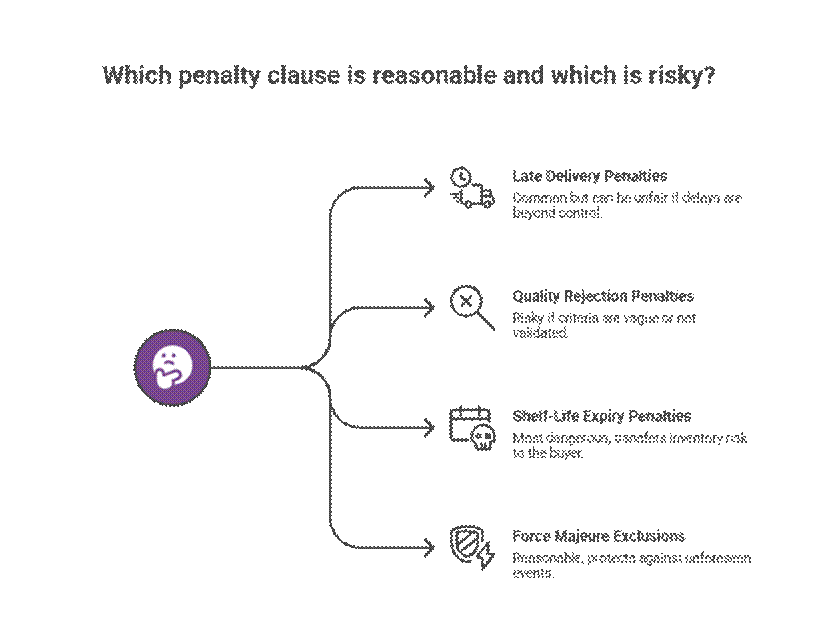
Penalty clauses are often viewed by buyers as safeguards. In reality, they are risk-allocation tools that determine who absorbs financial loss when timelines slip, quality issues arise, or inventory expires.
Common penalty types
- Late delivery penalties
These penalties are commonly triggered by missed shipment dates, regardless of the root cause.
- Quality rejection penalties
Quality penalties apply when finished goods fail agreed specifications. The risk arises when rejection criteria are vaguely defined or not tied to validated test methods.
- Shelf-life expiry penalties
These penalties are among the most commercially dangerous. When shelf-life definitions are unfavorable, expiry penalties effectively transfer inventory write-off risk to the brand—even if demand exists.
- Force majeure and exclusions
Force majeure clauses often exclude customs delays, port congestion, or carrier disruptions.
OEM reality:
Penalties shift responsibility—but do not eliminate operational risk. Strong contracts reduce failure likelihood rather than relying on penalties after losses occur.
Structuring MOQ Staging Instead of One-Time Commitments
One-time MOQ commitments concentrate commercial risk at the earliest and least certain stage of a product’s lifecycle. In contrast, a staged MOQ structure allows brands and OEMs to align volume commitments with validation milestones, reducing exposure while preserving production efficiency. This approach is central to an effective MOQ staging strategy for OEM manufacturing.

A staged approach typically includes:
- Pilot MOQ for formulation and process validation.
- Intermediate runs for stability, compliance, and retail testing.
- Scale volumes only after demand and logistics are proven.
OEM takeaway:
Staged MOQs reduce risk for both factory and brand by synchronizing commercial commitment with evidence. OEMs benefit from predictable capacity planning, while brands protect cash flow and flexibility as they scale.
Download Sample Shelf-Life & Penalty Clauses
Access example shelf-life definitions and penalty structures commonly used in OEM manufacturing agreements to benchmark your current contract language.
Negotiation Scenario: Where Terms Looked “Fine” — Until They Weren’t
A mid-sized oral-care brand negotiated what appeared to be a favorable deal: a relatively low 20,000-unit MOQ in exchange for accepting a 12-month shelf-life starting from the manufacturing date. The trade-off seemed reasonable—the unit price was competitive, and production ran on time.
What was underestimated was time erosion. After manufacturing, the shipment encountered a 6–8 week customs delay. By the time inventory cleared QA, inbound processing, and retailer onboarding, nearly three months of shelf-life had already elapsed.
Sales velocity was strong, but the remaining sell-through window was too short. Forty percent of the inventory expired before depletion. Penalty clauses triggered automatically, despite no quality failure.
What should have been negotiated differently:
Shelf-life start date tied to QA release, and a penalty cap tied to sell-through failure.
Clause that would have prevented the loss:
Shelf-life calculated from release date with expiry penalties excluded from logistics-driven delays.
Boardroom takeaway:
This loss was negotiated—not manufactured.
Factory Psychology: Why OEMs Push Back
Working with an experienced OEM personal care manufacturer means understanding how production decisions are influenced by line efficiency, raw material commitments, packaging requirements, and long-term capacity planning.
- Why factories push high MOQs
They protect tooling recovery, line efficiency, and raw material exposure. - Why they resist shelf-life guarantees
Shelf-life shifts post-production risk onto the OEM—especially risky without strong stability data. - When OEMs are flexible
When buyers reduce uncertainty through staged volumes, validated stability, and realistic timelines.
Negotiation truth:
OEMs become flexible when risk is reduced—not when pressure is applied.
Negotiation Levers Brands Commonly Miss
Many brands approach OEM negotiations focusing narrowly on unit price or headline MOQ. In practice, the most effective leverage points are structural—embedded in how risk, ownership, and timing are defined in the contract. Missing these levers increases manufacturing contract risk even when pricing appears competitive.
Commonly overlooked levers include:
- Flexible artwork and packaging terms.
Locking printed packaging too early amplifies write-off risk if formulations, claims, or regulations change.
- Partial ownership of raw materials.
In some cases, brands can negotiate ownership of unused raw materials or packaging components if production is halted or revised.
- Deferred penalties tied to validation milestones.
Rather than accepting immediate penalty exposure, brands can link penalties to clearly defined validation milestones—such as stability approval, retail acceptance, or logistics testing.
- Separation of commercial vs compliance liabilities.
Many contracts blur the line between commercial risk (forecast errors, demand volatility) and compliance risk (documentation gaps, regulatory changes).
Procurement insight:
Experienced buyers do not “negotiate harder”—they negotiate smarter, using structural levers that preserve flexibility, protect capital, and align risk with evidence rather than forecasts.
Import-Market Considerations (Why These Changes by Region)
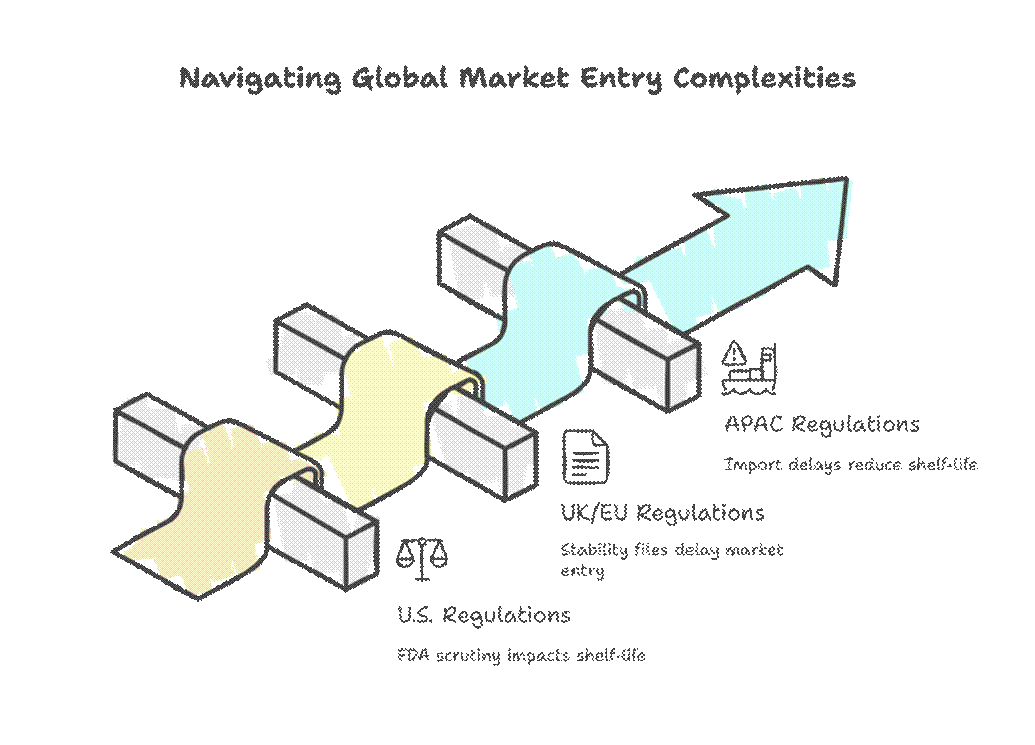
MOQ, shelf-life, and penalty negotiations cannot be standardized across markets. Regulatory timelines, retail onboarding processes, and customs clearance realities vary significantly by region, directly affecting effective sell-through windows and inventory risk.
- U.S.: Retail and FDA-driven shelf-life scrutiny
In the United States, oral-care products are subject to FDA expectations around stability, documentation, and post-market compliance. - UK / EU: Stability file and SCPN expectations
UK and EU markets require comprehensive stability documentation and product notification (e.g., SCPN). Approval and review timelines often exceed initial estimates, reducing effective shelf-life before products reach retail shelves. - APAC: Import clearance timing vs shelf-life loss
In many APAC markets, customs clearance, local testing, and documentation review introduce unpredictable delays.
Procurement insight:
Shelf-life negotiation must explicitly account for customs clearance and regulatory delay by region. Contracts that ignore import-market realities transfer timing risk entirely to the brand, often converting logistical friction into avoidable financial write-offs.
What Strong OEMs Will Agree To (And Weak Ones Won’t)
Not all OEMs approach risk the same way. The strongest manufacturing partners are transparent about how risk is priced, shared, and reduced over time.
- Transparent MOQ logic.
Strong OEMs can clearly explain how MOQs are calculated—whether driven by tooling amortization, line efficiency, or raw material commitments.
- Staged commitments.
Capable OEMs support staged MOQs that align volume increases with validation milestones. This approach reduces scale-up risk in OEM manufacturing while allowing factories to plan capacity responsibly.
- Shared validation responsibility.
Strong OEMs participate actively in stability testing, packaging validation, and transit trials. By sharing responsibility for validation outcomes, they reduce the likelihood of downstream disputes and manufacturing contract failures at scale.
- Clear documentation of ownership.
Robust OEM agreements clearly define ownership of formulations, stability data, tooling, and documentation. This clarity protects brands during audits, regulatory reviews, and supplier transitions—reducing documentation ownership risk in OEM contracts.
Procurement insight:
Experienced OEM partners reduce uncertainty through transparent communication, staged commitments, and clearly defined responsibilities. Weak OEMs rely on rigid terms and penalties to manage uncertainty. The difference becomes visible only at scale—when it is often too late to renegotiate.
Common Buyer Mistakes to Avoid
Even experienced procurement teams repeat the same contractual mistakes when negotiating with OEM factories. These errors often appear minor during early discussions but compound into significant financial loss at scale. Avoiding them is essential to reducing manufacturing contract risk in OEM sourcing.

- Negotiating price before MOQ logic
Focusing on unit price before understanding MOQ drivers leads to false savings. OEMs may recover risk through higher MOQs, restrictive shelf-life terms, or aggressive penalties—undermining the intended cost advantage and increasing hidden cost exposure in OEM contracts.
- Ignoring shelf-life until after production
Treating shelf-life as a post-production compliance issue eliminates negotiation leverage. Once inventory is manufactured, unfavorable shelf-life terms manufacturing becomes irreversible, often resulting in forced discounting or write-offs.
- Accepting blanket penalty clauses
Broad, undefined penalties transfer liability without addressing root causes. These clauses frequently trigger disputes and unexpected losses under OEM penalty clauses impact, especially during logistics disruptions or regulatory delays.
- Treating OEM contracts as fixed instead of staged
Contracts that do not evolve with volume and validation lock brands into early-stage assumptions. Failing to implement a staged OEM contract structure prevents renegotiation as evidence accumulates, exposing the brand to unnecessary scale-up risk.
Procurement takeaway:
Strong buyers avoid these mistakes by structuring contracts around evidence, timing, and risk allocation—rather than price alone.
Conclusion
MOQ, shelf-life, and penalty terms define commercial risk far more than unit price ever will. Brands that approach contracts through OEM MOQ negotiation and understand how volume commitments, sell-through timelines, and liability clauses interact are far better positioned to scale without margin erosion. When these terms are negotiated in isolation, hidden risk accumulates—often surfacing only after inventory is produced and capital is locked.
An OEM-led, system-level approach reduces manufacturing contract risk, protects cash flow, and preserves flexibility as demand grows. The right OEM partner helps brands structure agreements that scale safely and profitably—by aligning contracts with operational reality, not optimistic forecasts.
FAQs
Q1. Can MOQ be negotiated without increasing unit price?
Yes. MOQs can often be reduced without increasing unit price when brands lower factory risk elsewhere—such as through staged commitments, clearer shelf-life definitions, or shared validation responsibility.
Q2. How should shelf-life be defined contractually?
Where commercially agreed, brands may negotiate shelf-life calculation from batch release date rather than manufacturing completion date.
Q3. Are penalty clauses standard across OEMs?
No. Penalty structures vary significantly by factory, product category, and market. Assumptions about “standard” clauses often expose brands to unexpected OEM penalty clauses impact when delays or disputes arise.
Q4. When should MOQ staging be locked?
MOQ staging should be agreed in principle early, but finalized only after pilot validation and stability data are confirmed. Locking scale volumes too early increases manufacturing contract risk in scale-up.
Q5. Who owns expired inventory risk?
Expired inventory risk is owned by the party that accepts unfavorable shelf-life definitions and penalty clauses. In most cases, this is the brand—not the OEM—unless explicitly negotiated otherwise.
Q6. How do import delays affect shelf-life terms?
Import delays directly reduce effective sell-through time when shelf-life is calculated from the manufacturing date. This is a major driver of inventory expiry risk due to customs delays in export markets.
Q7. Should contracts change as volume scales?
Yes. OEM contracts should evolve as evidence replaces assumptions. Updating MOQs, shelf-life terms, and penalties as volume increases reduces long-term risk and aligns agreements with operational reality.
Q8. Can OEM factories reduce MOQ for first orders?
Yes, some OEM factories may support lower initial MOQs through pilot production, simplified packaging, shared components, or staged commitments.
Q9. What should brands prepare before negotiating OEM terms?
Brands should prepare target volume, market, packaging requirements, regulatory requirements, forecast expectations, and launch timeline before discussing MOQ and contract terms.
Request Manufacturing Risk Review Before Your Next PO
Negotiating MOQ, shelf-life, or penalty terms with an OEM factory?
Before confirming your next OEM production order, our team can help review MOQ structure, production requirements, packaging commitments, and timeline risks.