Introduction
Halal requirements are often misunderstood in oral care, leading many brands to over-certify—or to certify the wrong products entirely. A common mistake is applying food-grade Halal assumptions to categories that regulators and certifying bodies treat differently, such as toothpaste, mouthwash, and dental accessories. In reality, Halal rules vary significantly between food, cosmetics, and oral-care products.
Brands planning to launch toothpaste, mouthwash or oral spray should evaluate halal requirements alongside formulation, packaging and OEM oral care manufacturing planning.
This distinction matters commercially. Incorrect Halal assumptions add certification cost, delay market entry by weeks or months, and dilute margin without unlocking incremental sales. The real question for brands is not “Is Halal important?” but “Will Halal certification unlock distribution in this market for this SKU?” This article explains what truly applies, what does not, and how to make Halal certification oral-care decisions using an OEM-led, commercial lens—not default compliance.
What “Halal” Means in Oral-Care Context (Not Food Rules)
Oral Care vs Food vs Cosmetics
Oral-care products are not regulated as food, even though they are used in or around the mouth. This distinction is critical.
- Oral-care products are not ingested as food
Oral-care products are used in the mouth but are not consumed for nutrition, which places them outside standard food-category Halal rules.
- Regulatory treatment differs from consumables
Regulators assess oral-care products under cosmetic or functional product frameworks, focusing on ingredient origin and processing rather than dietary intake.
- Functional exposure vs dietary consumption
Regulators assess oral-care products under cosmetic or functional product frameworks, focusing on ingredient origin and processing rather than dietary intake.
From a Halal perspective, this shifts the focus away from ingestion and toward ingredient origin, processing method, and manufacturing controls, which are central to OEM Halal manufacturing.
Why Toothpaste & Mouthwash Are Treated Differently
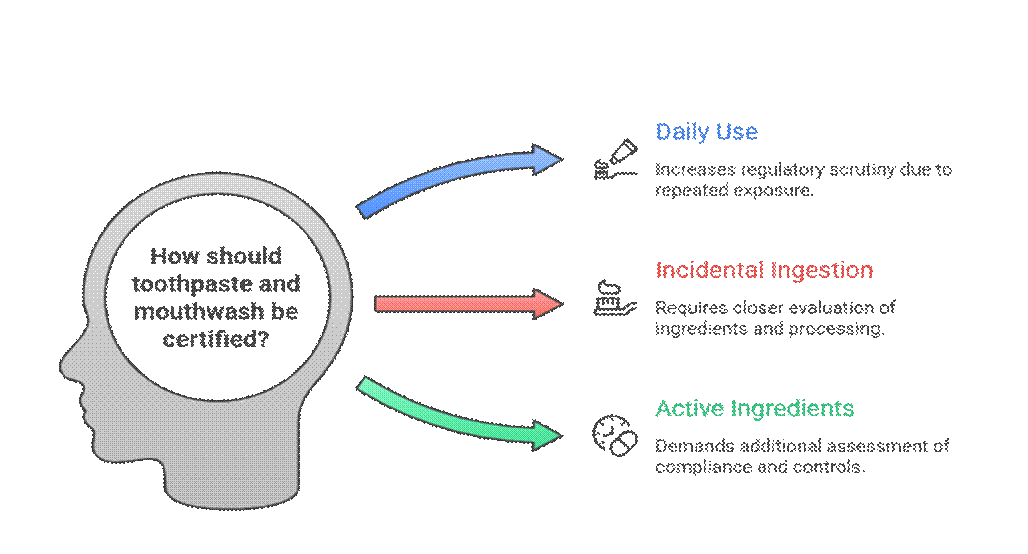
Daily use, incidental ingestion, and active ingredients explain why Halal certification requirements for toothpaste are evaluated more closely than non-ingestible oral-care categories.
- Frequency of use (daily, repeated exposure)
Toothpaste and mouthwash are used daily, often multiple times per day, which increases regulatory and certification scrutiny compared to occasional-use oral-care products.
- Incidental ingestion considerations
Small amounts of toothpaste or mouthwash may be unintentionally swallowed during use, prompting closer evaluation of ingredient origin and processing—even though the products are not classified as food.
- Active ingredients and contact time
These products contain active ingredients that remain in contact with oral tissue for longer periods, requiring additional assessment of ingredient compliance and manufacturing controls under Halal principles.
However, scrutiny does not automatically mean certification is mandatory. It means documentation and traceability matter.
OEM insight:
Halal assessment in oral care focuses on ingredient origin and processing, not taste, flavor, or nutritional ingestion.
Ingredients That Commonly Trigger Halal Questions
Most Halal-related delays do not come from formulation failure. They come from unclear documentation around a small set of ingredients.
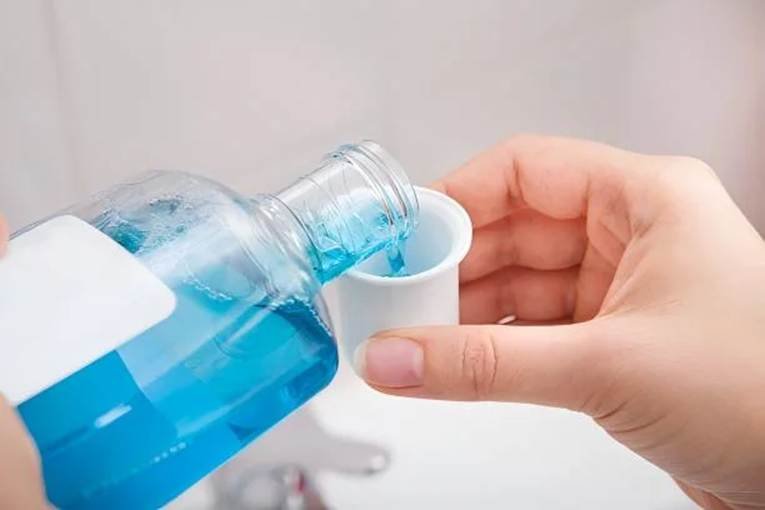
Alcohol (Ethanol) in Mouthwash
Alcohol is the most common point of confusion.
- Intoxicating vs functional alcohol
Halal assessment distinguishes between alcohol intended for intoxication and ethanol used functionally as a solvent, stabilizer, or preservative in oral-care formulations. - Low-percentage ethanol
Many mouthwashes use ethanol at low concentrations for formulation stability or antimicrobial performance, which may be acceptable depending on certifying body guidance. - Market-by-market interpretation
Acceptance of functional ethanol varies by region, retailer, and certifying authority, making market-specific evaluation essential rather than assuming a global standard.
This distinction sits at the center of Halal mouthwash compliance and must be assessed per market, not assumed globally.
Glycerin (Plant vs Animal Derived)
Glycerin is widely used in toothpaste and oral-care formulations.
- Source traceability requirements
Glycerin must be clearly identified as plant-derived or synthetic, as animal-derived glycerin may require Halal verification.
- Documentation OEMs must provide
OEMs are expected to supply supplier declarations, origin statements, and traceability documents to confirm Halal suitability.
Missing glycerin declarations are a common cause of certification delays under Halal toothpaste requirements.
Flavorings, Sweeteners & Enzymes
These ingredients raise questions when they are:
- Fermentation-derived inputs
Ingredients produced via fermentation may raise Halal questions depending on substrates and processing methods. - Supplier declarations
Ingredients produced via fermentation may raise Halal questions depending on substrates and processing methods.
Procurement note:
Most Halal delays originate from missing or incomplete supplier documentation, not from formulation failure. Early documentation review is often more effective than reformulation when addressing Halal compliance concerns.
Common Oral-Care Ingredients & Halal Risk Levels
| Ingredient | Typical Source | Halal Concern | Documentation Needed |
| Ethanol (Alcohol) | Synthetic or fermentation-derived | Intoxicating vs functional use | Functional-use statement, concentration disclosure |
| Glycerin | Plant, synthetic, or animal-derived | Animal origin verification | Supplier origin declaration, Halal status letter |
| Flavorings | Natural, synthetic, or blended | Fermentation substrates | Supplier Halal certificate or declaration |
| Sweeteners (e.g., sorbitol) | Synthetic or plant-derived | Processing aids | Ingredient specification, origin statement |
| Enzymes | Fermentation-derived | Source and growth media | Supplier declaration, production process summary |
This table helps procurement and quality teams quickly identify which oral-care ingredients typically trigger Halal review and what documentation is required to address concerns without unnecessary reformulation or certification delays.
When Halal Certification Is Typically Required

Retail Requirements in Muslim-Majority Markets
Understanding when Halal certification is required for oral-care products prevents over-certification in low-risk markets while protecting access in Halal-sensitive retail channels.
- Middle East (GCC countries)
Halal certification is commonly expected by retailers and distributors for toothpaste and mouthwash, particularly in mass retail and pharmacy channels. - Malaysia and Indonesia
Halal compliance plays a central role in retail acceptance, with formal frameworks and recognized certification bodies influencing market access. - Selected African markets
In some Muslim-majority African countries, Halal certification is requested by importers or retailers as a condition of listing, even when not explicitly mandated by regulation.
In these regions, certification often functions as a market-access requirement, even when not explicitly mandated by law.
Retailer vs Regulatory Demands
It is critical to distinguish between:
- Government requirement vs buyer preference
In many markets, Halal certification is not legally required but is strongly preferred—or informally required—by retailers and distributors. - Private-label retail mandates
Private-label programs frequently impose Halal certification as part of their supplier standards, regardless of regulatory necessity.
OEM insight:
Halal certification is often a commercial requirement, not a legal one. Understanding whether certification unlocks distribution—or merely adds cost—is essential to making sound market-entry decisions.
When Halal Certification Is NOT Required
Non-Food Oral-Care Categories
Many oral-care products do not require Halal certification:
- Toothbrushes and manual accessories
Manual toothbrushes, floss, and similar accessories are generally not subject to Halal certification, as they do not involve ingestible components. - Whitening strips (non-ingestible)
Products designed for external or surface application, with no ingestion pathway, are typically outside the Halal certification scope. - External-use dental products
Items intended solely for external oral use are usually assessed through standard cosmetic or medical-device frameworks rather than Halal certification.
Certifying these categories rarely unlocks new distribution.
Markets Where Documentation Suffices
In some markets, the following are sufficient:
- Ingredient declarations
Clear documentation confirming ingredient origin and processing often satisfies buyer and distributor requirements without formal certification. - Alcohol-free claims vs Halal logos
In some markets, alcohol-free labeling or supplier declarations are accepted in place of a Halal logo, particularly outside Muslim-majority regions.
Procurement takeaway:
Misapplying Halal certification can add cost and delay without increasing market access or sales. Careful assessment of product type, market expectations, and documentation requirements helps avoid unnecessary certification.
Halal Required vs Optional vs Not Applicable — By Product Type
| Product Type | Muslim-Majority Markets (GCC, MY, ID) | Mixed Markets | Non-Muslim-Majority Markets |
| Toothpaste | Required / Strongly Expected | Optional | Not Applicable |
| Mouthwash | Required / Strongly Expected | Optional | Not Applicable |
| Oral Spray | Often Required (case-by-case) | Not Applicable | Not Applicable |
| Toothbrushes & Accessories | Not Applicable | Not Applicable | Not Applicable |
Purpose of visual:
This matrix helps procurement and regulatory teams quickly determine when Halal certification is mandatory, optional, or unnecessary based on product type and target market—supporting faster, cost-efficient market entry decisions.
Request Halal Documentation Pack
Preparing for export or retailer review?
Request a sample Halal documentation pack (ingredient declarations, supplier letters, process summaries) to understand what buyers and auditors actually expect.
Cost of Halal Certification vs Commercial Return (ROI Lens)
Halal certification should be evaluated as a commercial investment, not a default compliance expense. For oral-care brands, the key question is whether certification unlocks incremental distribution, listings, or revenue that justify the added cost and time.
Typical Cost & Timing Ranges (Illustrative Only)
- Certification cost: USD 2,000–8,000 per SKU / manufacturing siteCosts vary based on product type, facility readiness, and certifying body. These figures are indicative ranges, not universal benchmarks.
- Audit & approval timeline: 6–12 weeks (varies by body and region)
Costs vary based on product type, facility readiness, and certifying body. These figures are indicative ranges, not universal benchmarks.
These ranges are not universal and depend on product type, facility readiness, and certifying body.
Commercial Considerations
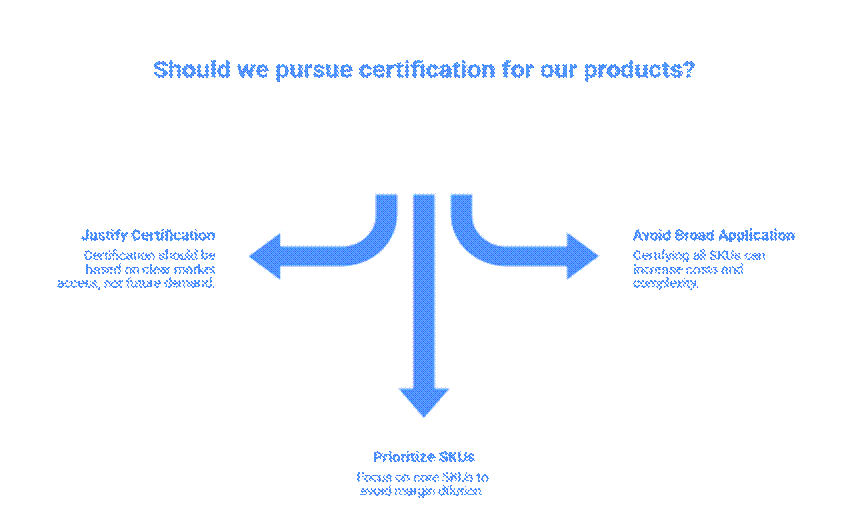
- Certification cost vs expected incremental revenue
Certification should be justified by clear access to new retailers, distributors, or export markets—not assumed future demand.
- SKU prioritization (core vs fringe SKUs)
Certification should be justified by clear access to new retailers, distributors, or export markets—not assumed future demand.
- Margin dilution if certification is applied broadly
Certifying all SKUs by default can dilute margins through direct certification fees, extended lead times, and added operational complexity.
Boardroom takeaway:
Halal certification should be applied where it directly unlocks distribution or retail acceptance. Treating it as a blanket requirement across all SKUs often increases cost and delays without delivering proportional commercial return.
Halal Go / No-Go Decision Framework
Use this framework to decide when Halal certification is necessary—and when it is not.
Decision Logic
| Factor | Go (Certify) | No-Go (Do Not Certify Yet) |
| Target market | Indonesia, Malaysia, select GCC retail | Non-Muslim-majority markets |
| Product type | Toothpaste, mouthwash | Accessories, non-ingestible SKUs |
| Retailer requirement | Logo explicitly required | Documentation accepted |
| Margin vs cost | Incremental revenue > certification cost | Cost dilutes margin |
| OEM readiness | Documentation & audit support ready | Gaps remain |
Decision rule:
Proceed with Halal certification only when market access unlocked outweighs certification cost, time, and margin impact. This framework helps brands avoid unnecessary certification while protecting access in sensitive markets—a core element of Halal certification ROI for oral-care brands.
Practical Example: Certifying Only One SKU (NEW)
A regional oral-care brand planned to launch six SKUs into Southeast Asia. The initial instinct was to Halal-certify the entire range. OEM review showed that only toothpaste and mouthwash were required for distributor onboarding.
The brand certified one toothpaste SKU first, using it to secure listings and validate demand. Accessories and whitening products launched with documentation only. Certification costs were reduced by more than half, timelines shortened, and cash preserved for marketing and inventory.
After six months of sell-through validation, the second SKU was certified selectively.
Lesson:
Halal certification timing matters as much as certification itself.
OEM Role in Halal Compliance (What Factories Actually Do)
Strong Private Label Mouthwash Manufacturer reduce audit friction by maintaining complete Halal documentation for oral-care products, including ingredient origin mapping, supplier declarations, and batch-level traceability.
Ingredient Traceability & Supplier Declarations
OEMs manage:
- Halal status letters
OEMs collect and maintain Halal declarations from ingredient and packaging suppliers, confirming source, processing method, and compliance status.
- Batch-level documentation
Traceability records link each production batch to approved raw materials, enabling auditors to verify Halal compliance without requiring reformulation or rework.
Manufacturing Line Controls
- Cross-contamination prevention
OEMs implement segregation controls to prevent contact between Halal-compliant and non-compliant materials during production and storage. - Cleaning and segregation protocols
Documented cleaning and sanitation procedures ensure production lines meet Halal requirements before manufacturing certified oral-care SKUs.
Certification Bodies & Audit Scope
- What auditors review
Auditors typically examine ingredient origins, supplier declarations, production records, cleaning logs, and traceability systems.
- What they do not review
Marketing claims, branding language, and commercial positioning are generally outside the scope of Halal audits unless they misrepresent compliance.
OEM authority point:
A qualified OEM reduces Halal risk before certification is requested, not after audits fail—central to OEM-managed Halal compliance process.
Common Brand Mistakes With Halal Certification
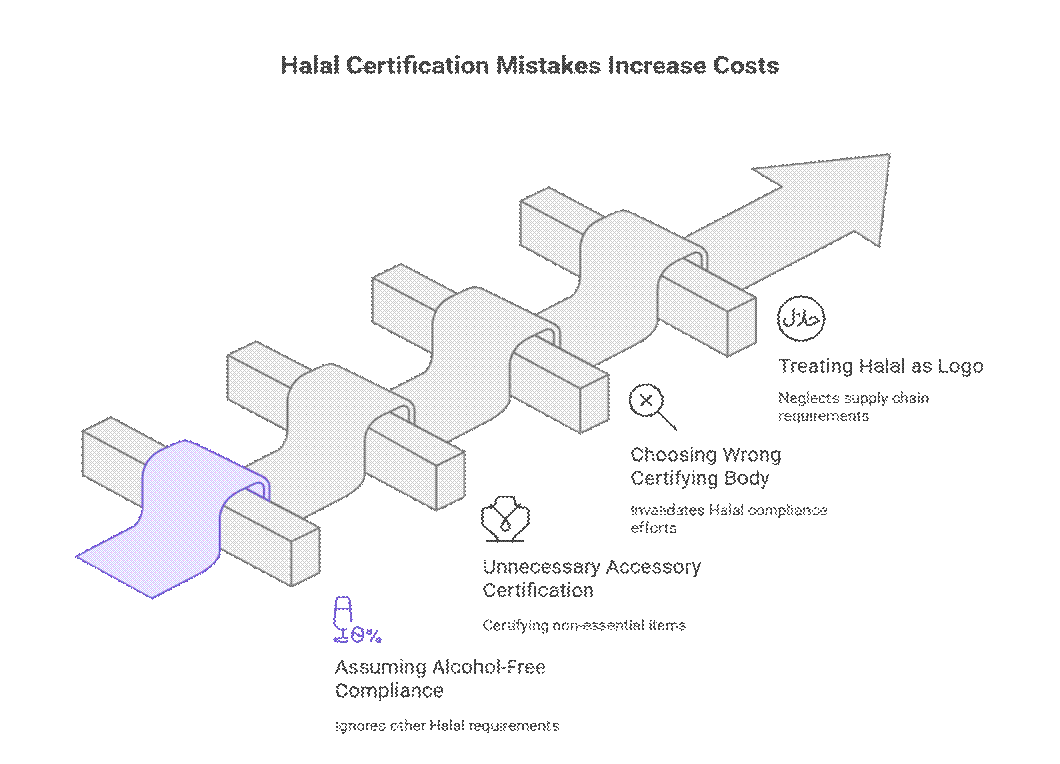
Brands most often fail by:
- Assuming “alcohol-free” equals Halal-compliant.
- Certifying accessories unnecessarily.
- Choosing the wrong certifying body.
- Treating Halal as a logo instead of a supply-chain process.
Each mistake increases cost without improving compliance or access.
Import-Market Nuances Brands Must Understand
UAE
- Halal often retailer- or distributor-driven.
- Documentation is frequently accepted without a logo.
Saudi Arabia
- Stricter enforcement in certain retail channels.
- Greater scrutiny of alcohol-containing mouthwash.
Indonesia (BPJPH)
- Mandatory Halal framework expanding.
- Formal certification pathway more rigid.
Malaysia (JAKIM)
- High documentation standards.
- JAKIM-recognized certification bodies preferred.
Halal Certification Pathways by Region
| Market | Halal Requirement Level | Primary Driver | Documentation Typically Accepted | Certification Pathway |
| UAE | Optional / Retailer-driven | Distributor & retailer preference | Ingredient declarations, supplier Halal letters | Certification only if retailer explicitly requires logo |
| Saudia Arabia | Often expected (select channels) | Retail chains & pharmacy groups | Full ingredient traceability, alcohol-use justification | Recognized Halal certification body recommended |
| Indonesia (BPJPH) | Increasingly mandatory | Government regulation | Complete ingredient, process, and supplier files | Formal BPJPH certification pathway |
| Malaysia (JAKIM) | Strongly expected | Regulatory + retail standards | Detailed traceability, supplier declarations | JAKIM-recognized certification body required |
How to Decide If Your Oral-Care SKU Needs Halal Certification
Use a structured evaluation rather than assumptions when deciding whether to pursue Halal certification. Not every oral-care product or market requires it, and unnecessary certification adds cost, complexity, and time without improving commercial outcomes.
- Product type.
- Ingredient risk profile.
- Target market.
- Retail channel expectations.
Decision rule:
Certify only when Halal certification unlocks market access or retail acceptance. Treating certification as a default requirement often increases cost and delays without delivering incremental sales or strategic advantage.
What Strong OEMs Provide for Halal Readiness
Strong OEM partners do more than respond to Halal audit requests—they proactively structure systems and documentation to reduce certification risk before it affects timelines or cost. This level of OEM Halal readiness allows brands to pursue certification quickly when market access requires it—without delaying production or relabeling SKUs.
For private label projects that need market-specific formulation and compliance documentation, production runs through ORALABX, RuiqiGO’s dedicated oral care manufacturing division. See the ORALABX supplier qualification and audit support page.
- Ingredient origin mapping.
- Documentation packages.
- Pre-audit readiness checks.
- Coordination with certifying bodies.
Conclusion
Halal certification in oral care is often misunderstood and misapplied. Brands that certify by default incur unnecessary cost, operational complexity, and launch delays, while brands that ignore Halal requirements where they genuinely apply risk distributor rejection or failed market entry.
The right OEM partner helps brands clearly distinguish between what applies and what does not—structuring Halal certification oral-care as a targeted market-access tool rather than a blanket compliance burden. When approached this way, Halal compliance supports commercial expansion by balancing regulatory alignment, speed to market, and sustainable margin.
FAQ
Q1. Is toothpaste considered Halal food?
No. Toothpaste is not regulated or assessed as food. While it is used in the mouth, it is treated as an oral-care or cosmetic product, with Halal evaluation focused on ingredient origin and manufacturing processes rather than dietary consumption.
Q2. Can mouthwash contain alcohol and still be Halal?
In some markets, yes. Low-percentage ethanol used functionally as a solvent or preservative may be acceptable depending on the certifying body and market interpretation. Documentation and formulation context are critical.
Q3. Do toothbrushes require Halal certification?
Generally no. Manual toothbrushes and non-ingestible oral-care accessories typically fall outside the scope of Halal certification.
Q4. Who issues Halal certificates for oral-care products?
Halal certificates are issued by recognized Halal certification bodies. Acceptance depends on the target market, with some regions requiring certificates from specific or government-recognized authorities.
Q5. Does Halal certification apply globally?
No. Halal requirements vary significantly by region, retailer, and product type. Certification that is essential in one market may be optional or unnecessary in another.
Q6. How long does Halal certification take?
Timelines typically range from 6 to 12 weeks, depending on documentation readiness, audit scope, and the certifying body involved.
Q7. Can OEMs manage Halal audits on behalf of brands?
Yes. Experienced OEMs often coordinate documentation preparation, audits, and communication with certifying bodies, reducing delays and ensuring compliance requirements are met efficiently.
Request Halal Compliance Assessment
Exporting oral-care products into Halal-sensitive markets?
Request an OEM-led Halal compliance assessment to confirm requirements, evaluate ROI, and avoid unnecessary certification before committing time, cost, or margin.