Many buyers use OEM, ODM, and private label interchangeably. However, they involve very different development costs, timelines, MOQ requirements, and levels of customization. Choosing the right model affects development cost, MOQ, timeline, and how much control your brand has over the final product.
Choosing the wrong model often results in higher development costs, longer timelines, or MOQ requirements that do not fit your business stage.
This guide breaks down the true operational differences between all three models so you can make an informed decision based on your current upfront investment and shipping schedule
Personal Care Manufacturing Models at a Glance
Before we get into the fine details, here is a quick snapshot of how each manufacturing model compares across production, financial, and regulatory metrics.
| Evaluation Metric | Private Label | ODM (Original Design) | OEM (Original Equipment) |
| Formula Ownership | Usually manufacturer-owned existing formula | Manufacturer-developed formula with customization options | Brand-specific formula ownership defined by agreement |
| Product Customization | None (Packaging and label tweaks only) | Moderate (Base formula plus scent, color, minor actives) | Absolute (Custom formulations built from scratch) |
| MOQ(Typical ranges vary by product category and packaging format.) | 10,000 units per SKU | 10,000 units per SKU | 10,000 units per SKU; sachet and single-dose formats carry separate minimums |
| Time to Market | Confirmed after formula, packaging, compliance, and order review | 2 to 4 months | 6 to 12+ months for R&D and testing |
| Regulatory Responsibility | Shared (Factory provides existing MoCRA data) | Shared (Factory assists with safety dossier) | Highest (Brand handles independent safety substantiation) |
| Upfront R&D Cost | Zero | Minimal | $3,000 to $20,000+ per formula |
| Best Fit For | Fast market validation / Amazon FBA | Agility with slight product differentiation | High-capital brands with unique formulation requirements |
What Is the OEM Manufacturing Model in Personal Care?
OEM stands for Original Equipment Manufacturing. Under this model, you hire a personal care manufacturer to physically blend a proprietary recipe that your brand or development partner defines the technical specifications. The factory builds the product entirely to your technical specifications, meaning the final chemical intellectual property belongs completely to your brand.
This model gives you total creative and scientific freedom over your product line:
- Formulation Control: You dictate the exact active ingredient selection, the concentration percentages, and the processing methods.
- Exclusive Ownership: No other brand using that factory can access or duplicate your recipe because it is your proprietary IP.
- Claims Freedom: Your marketing and performance claims are backed by your own specific formula data.
Financial and Timeline Realities
The trade-off for absolute control is a much heavier demand on your upfront budget and production timeline:
- Upfront R&D Fees: Developing a custom formula through an independent cosmetic chemist can range from $3,000 to $20,000, depending on complexity.
- Testing Costs: Stability testing, microbiological screening, and compliance documentation generally add $1,000 to $5,000 per SKU.
- Extended Timelines: The full development cycle from your initial brief to approved production batches takes anywhere from six to twelve months.
- Higher Minimums: Because the factory must configure its production lines for a completely unique formula, minimum order quantities typically start between 5,000 and 10,000 units per SKU.
When to Choose an OEM Manufacturer
This model is the right path if your business fits these specific criteria:
- You own a patented active ingredient or a proprietary raw material processing method.
- You are building a long-term enterprise brand where formula ownership is vital for owning your proprietary manufacturing specifications.
- Your strategy revolves around deep product differentiation that cannot be easily replicated by competitors.
This model forms the backbone of custom personal care manufacturing, providing the necessary infrastructure for brands that need to build custom chemical specs from the ground up instead of relying on stock inventory.
What Is the ODM Manufacturing Model for Personal Care?
ODM stands for Original Design Manufacturing. Under this model, you are not starting your formulation from scratch. Instead, the factory provides a pre-developed, stability-tested, and market-validated library of base formulas. You select a proven base and customize it to match your brand identity.
Think of ODM as an option that sits between private label and full OEM. It gives your product a unique formula modification without the steep development costs of building a recipe from zero:
- Aesthetic Adjustments: You can modify the color and texture to fit your visual branding.
- Signature Scent Profiles: You can work with the factory to swap out the standard fragrance for a custom essential oil blend or specific fragrance compound.
- Active Ingredient Infusions: You can layer trending extracts, such as niacinamide, hyaluronic acid, or oat extract, into the pre-made base to anchor your claims.
Lower Production Risk and Shorter Timelines
Because the underlying chemistry is already proven, the ODM model removes the technical roadblocks that often stall new brands:
- Eliminated Stability Risk: The base formula has already cleared rigorous heat, light, and microbiological protocols at the factory level. You do not have to worry about a formula separating or failing testing six months into your project.
- Lower Production Barriers: Minimum order quantities are much more accessible than OEM, typically sitting between 3,000 and 5,000 units.
- Accelerated Launch: Because the foundational R&D is already finished, your production timeline drops significantly to just two to four months after your custom sampling rounds are locked in.
When to Choose an ODM Manufacturer
This model is best suited for your business if:
- You want to launch an agile line faster than a full six-to-twelve-month OEM cycle allows.
- You want to eliminate the financial risk of custom formulation failures while still owning a unique product look and feel.
- You are expanding your catalog or testing a new category before investing in proprietary chemical assets.
Sourcing your inventory through a specialized body care manufacturer with a deep library of pre-stabilized rinse-off and leave-on bases lets you skip the initial laboratory phase entirely, allowing you to increase your production volume safely.
What Is the Private Label Manufacturing Model?
Private label, sometimes called white label, is the fastest entry point into the personal care industry. The factory handles the entire formulation process, keeping finished bases in active production. You simply select a formula from their existing catalog, apply your brand design, and move straight to distribution.
This model eliminates the operational hurdles of traditional manufacturing, which is why it is highly favored by established brands and commercial buyers seeking a defined route to market:
- Zero R&D Hassle: There is no formulation development cycle or stability testing to fund; the factory provides the pre-existing regulatory data.
- Defined Commercial Entry: Minimum order quantities are confirmed by product type, formula, packaging configuration, and production requirements.
- Defined Development Scope: Lead time is confirmed after the formula, packaging, compliance, and commercial order requirements have been reviewed.
The Reliability of Stock Formulas
A frequent misconception is that private label means inferior quality. In reality, stock formulas are often a factory’s most stable and high-performing products. Because they are manufactured continuously at high volumes, the production team has perfected the process, ensuring excellent batch consistency and minimizing the risk of formula separation over time.
The Trade-Off: Formula Ownership
The primary limitation is intellectual property. You do not own the formula, and other brands can utilize the exact same base. Your market differentiation must come entirely from your packaging, storytelling, and targeted brand positioning rather than a proprietary chemical system.
When to Choose It
This model is ideal when your primary competitive advantage is speed to market, or when you need to validate consumer demand before committing to a custom formulation budget.
It is also highly efficient for brands scaling horizontally. Evaluating turnkey stock options from an established shampoo manufacturer, body wash manufacturer, and body lotion manufacturer allows you to launch a complete, multi-category line under a single, consolidated compliance workflow.
Which Model Fits an Initial Commercial Programme?
Private label can suit established brands seeking a production-ready formula and a clearly defined first commercial programme.
Sourcing a production-ready formula can reduce development scope and provide a clearer path from product selection to commercial production. Timing and MOQ are confirmed after the formula, packaging, compliance, and order requirements have been reviewed.
Sourcing through an established private label shampoo manufacturer or body wash manufacturer gives you immediate access to compliant, mass-production-ready formulas so you can focus 100 percent on driving initial order volume.
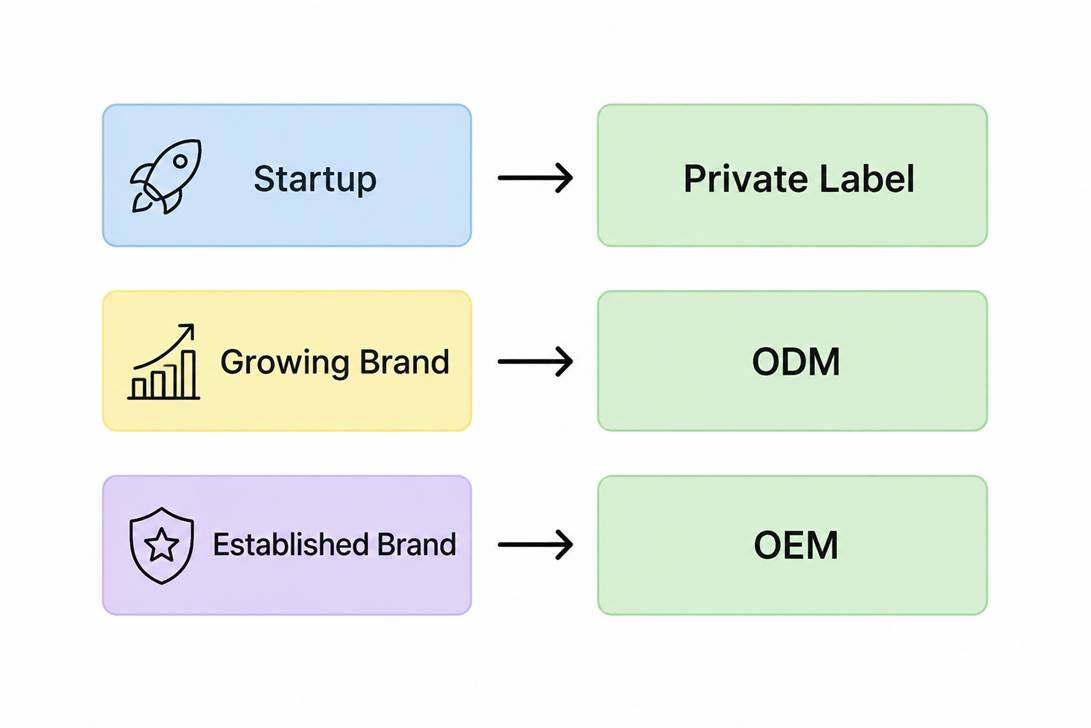
As purchasing demand, distribution, and product differentiation requirements expand, the appropriate manufacturing model may change:
Growing Brands
Once your sales are consistent and you need to set your products apart on the shelf, transition to ODM. This allows you to introduce custom scents, colors, or specific active ingredients into pre-stabilized bases. The applicable MOQ depends on the product, formula, packaging configuration, and confirmed production requirements.
Established Brands
When you have secured large-scale retail distribution, possess strong capital backing, and require absolute ownership over your chemical IP, move to OEM.
This pathway is built for companies that need custom formulations developed from scratch and have the budget ($15,000+ per SKU) and timeline flexibility (6 to 12 months) to handle independent stability testing and heavy factory MOQs.
A common industry progression is to launch via private label to validate your audience, transition to ODM to introduce signature branding variations, and finally invest in full OEM custom blending once your established sales volume and distribution contracts justify the heavy upfront investment.
Common Misconceptions About OEM, ODM, and Private Label Manufacturing
Misunderstandings about factory operations often lead sourcing teams to make decisions based on industry assumptions rather than verified production requirements.
Myth 1: Private Label Equals Low Quality
This is the most persistent misconception in personal care. Stock formulas are often the most stable, thoroughly tested products a factory offers precisely because they are in constant, high-volume production. A formula that has been filled at scale for years has had every production variable optimized, making it a manufacturing advantage rather than a cheap compromise.
Myth 2: OEM Is Always the Superior Model
Custom formulation is powerful, but it should not be your default choice. Committing to full OEM before establishing distribution channels or proving consumer demand forces you to absorb high development risks early on. Many established brands launch new categories using private label to validate the market, investing in custom OEM development only after sales data justifies the capital.
Myth 3: ODM Products Offer Zero Differentiation
Two brands can use the same ODM base formula and create completely different retail products. Differentiation happens effectively above the formulation level through simple modifications:
- Fragrance: Scent heavily dictates consumer perception and emotional brand alignment.
- Primary Packaging: Altering the bottle shape, cap style, or material changes the visual language entirely.
- Marketing Focus: Leading with a specific active extract on your label creates an entirely distinct narrative.
Personal Care Manufacturing Across Multiple Categories
RuiqiGO supports brands across multiple personal care categories, including:
- Oral care manufacturing
- Hair care manufacturing
- Body care manufacturing
Whether you are producing rinse-off hair care, topical body treatments, or entering oral care manufacturing, your choice should align with your budget, production timeline, and formula ownership needs.
Frequently Asked Questions About OEM, ODM, and Private Label Manufacturing
What is the primary difference between OEM and ODM?
In an OEM setup, your brand owns the formula outright, and the factory blends it strictly to your custom specifications. In an ODM arrangement, the manufacturer retains ownership of the foundational formula base, allowing you to select and modify options from their pre-existing library. OEM gives you full formula specification ownership, while ODM prioritizes rapid production timelines and lower development costs.
Is ODM cheaper than OEM?
Yes. ODM cuts out the major upfront investment required for independent cosmetic laboratory chemistry, raw material sourcing trials, and custom safety substantiation. Because you are customizing a base that the factory has already stability-tested and registered, your initial development cost drops significantly.
What is the MOQ difference between OEM and private label?
MOQ varies by product, formula, packaging, filling-line requirements, and testing scope. Private label may reduce development work by using an existing formula platform, while OEM requirements must be confirmed after technical and commercial review.
How do I choose between OEM, ODM, and private label manufacturing?
The right choice depends on customization requirements, compliance scope, expected volume, packaging, and distribution readiness. Private label or ODM may suit projects using production-ready systems, while OEM is more appropriate when formula ownership and differentiation are priorities.
Is private label cheaper than OEM?
Yes, private label is significantly more cost-effective during the initial launch phase. It requires zero upfront R&D or stability testing fees because you are using an established product. Custom OEM formulation, by contrast, typically requires an investment of $3,000 to $20,000 per recipe before commercial manufacturing even begins.
Who owns the formula in OEM manufacturing?
Your brand owns it completely. Because the recipe is engineered entirely to your technical parameters, it functions as your proprietary chemical IP. The contract manufacturer has no legal right to produce or distribute that exact formulation for any other client in their portfolio.
Can I switch from private label to OEM later?
Absolutely. Transitioning to custom formulations once you have validated consumer demand is a standard way to scale. While you will need to develop a brand-new formula from scratch rather than simply buying out the private label base, using your real-world sales data makes that transition a much safer investment.
Which option is best for a new brand?
It depends on the approved commercial brief, distribution readiness, required customization, and production timeline. Private label or ODM may suit projects that can use an established formula platform. Full OEM is more appropriate when the brand has confirmed technical requirements, compliance scope, packaging direction, and commercial volume.
Which option usually has the lowest MOQ?
MOQ cannot be determined by the manufacturing model alone. Product type, formula, packaging components, filling-line requirements, testing scope, and confirmed commercial volume must be reviewed before a production minimum is issued.
Start Your Brand With a Versatile Sourcing Partner
There is no single best manufacturing model for launching a personal care line. The optimal choice depends entirely on your current budget, your production timeline, and your customization level.
Here is a summary that can guide your decision:
- If you need fast entry with minimal upfront financial risk, choose private label to launch proven and high-volume formulas quickly.
- If you want a differentiated brand presence without long lab timelines, choose ODM to customize pre-stabilized bases with signature scents and active ingredients.
- If you require absolute intellectual property ownership and custom chemistry, choose OEM to engineer a completely proprietary formula from scratch.
At RuiqiGo, we are your full-range manufacturing partner providing the agile physical infrastructure you need to support all three operational pathways. Whether you need a turnkey private label rollout or full-scale custom OEM development, we handle everything from strict quality control to global raw material sourcing.
Ready to turn yourplan into a physical product line?
Contact RuiqiGO to map out your production blueprint, evaluate your current options, and establish a realistic production timeline.