Finding a personal care OEM manufacturer in China takes about ten minutes on Alibaba. Finding one that consistently delivers on-spec formulations, communicates transparently when a batch goes off-schedule, and scales with your inventory demands is a completely different challenge.
Most sourcing mistakes happen when you stop evaluating once you see an acceptable unit price. A supplier that looks highly competitive on paper can easily become your most expensive asset due to rejected shipments, formulation drift, stability failures, and compliance bottlenecks that surface only after your product hits retail shelves.
This guide outlines the practical, on-the-ground steps you must take to vet, verify, and select an OEM partner in the personal care space as a US brand owner, an Amazon FBA seller, or a product sourcing manager.
What Should You Look for Beyond Price?
When you request quotes from five factories and one comes back 30% cheaper than the rest, that quote requires your highest level of scrutiny.
In personal care manufacturing, extreme undercutting always points to a compromise down the line. It usually means lower-grade raw material lots, loose fill-weight tolerances, or skipped microbiological and stability testing.
For instance, let’s say a factory cuts corners on emulsifier quality or switches to an unbranded stabilizer to drop your cost. Your formulation might look perfect during sign-off, but face phase separation six months later in a warm warehouse. Recalling a broken emulsion and managing the fallout with your retail accounts wipes out any initial savings you made on unit margins.
When scouting a personal care supplier, check pricing, but watch out for other factors too. The operational indicators that actually predict a reliable partnership include:
- Dedicated Production Infrastructure: A facility built for your high-volume, rinse-off liquid production uses entirely different compounding tanks and filling lines than one optimized for anhydrous balms or color cosmetics. Confirm active, dedicated lines for your specific product format rather than generic catalog listings.
- Verified Quality Management: Look for active Good Manufacturing Practices (GMP) alignment, ISO 22716 compliance, and real-time batch testing records that prove daily operational discipline.
- Transparent Technical Communication: Gauge how the factory handles your technical inquiries from day one. If their engineering or formulation responses are vague, defensive, or delayed during the quoting stage, that friction will only compound once they hold your deposit.
- Iterative Sampling R&D: A factory that documents your formulation adjustments systematically during sample rounds shows you exactly how they will handle production troubleshooting later.
Before narrowing down your supplier list, it helps to know what a fully compliant, professional setup looks like. Reviewing an established personal care manufacturing workflow can give you a baseline for standard testing timelines and quality benchmarks before you sign a contract.
Typical MOQ Expectations by Product Category
Minimum Order Quantities (MOQs) in personal care are driven by compounding tank capacities and high-speed filling line efficiencies. Factories cannot run a 1,000 kg vacuum emulsifier mixer for your 200-bottle run without experiencing massive product yield loss and unsustainable cleaning downtime.
When you negotiate with Chinese OEM manufacturers, expect your initial order requirements to fall within these standard industry ranges, depending on your formulation complexity and packaging requirements:
Personal Care Sourcing MOQs
| Product Category | Typical MOQ Range (Units) | Primary Driver of MOQ |
| Shampoo | 5,000 – 10,000 | Large compounding tank yields; automated filling line efficiency. |
| Body Wash | 5,000 – 10,000 | Standard raw material batch sizes; economical surfactant sourcing. |
| Body Lotion | 3,000 – 5,000 | Emulsion stability complexity; vacuum emulsifier capacity limits. |
| Oral Spray | 10,000 – 20,000 | Small fill volumes require long automated line runs for stability. |
| Mouthwash | 5,000 – 10,000 | Large liquid volume handling; specialized bottle molding requirements. |
Sourcing Note: While a factory may occasionally agree to lower your initial units to secure a contract, they will often charge you a premium on the unit price or require you to purchase the packaging materials (bottles, pumps, caps) at their full component MOQ (typically 10,000 pieces) and hold the excess inventory for your future runs.
How to Verify a Manufacturer’s Credentials
Every personal care manufacturer in China claims full compliance and top-tier certifications. To protect your supply chain, you must independently audit these assertions rather than relying on sales presentations.
Use this due diligence checklist to vet candidates before you wire-transfer any deposits:
- Business License Verification: Request the factory’s Chinese business license and look up their profile on China’s National Enterprise Credit Information Publicity System. Verify their official business scope. If their registered scope lists trading or wholesale rather than manufacturing or production, you are dealing with a middleman, not the factory.
- GMP and ISO Documentation: Do not accept low-resolution certificate logos. Request full copies of their GMP (GMPC) and ISO 22716 certificates. Cross-check the issuing body, certificate number, active validity dates, and the specific facility address listed on the document against their business license.
- FDA Registration: If your target market is the United States, the manufacturing facility must be registered under the FDA’s Modernization of Cosmetics Regulation Act (MoCRA). Validate the facility registration number directly against the public FDA database to ensure it is active and free of your target market’s open import alerts.
- Third-Party Audit Reports: Ask for unredacted copies of recent independent facility audits conducted by recognized bodies like SGS, Intertek, or Bureau Veritas. A factory that shares these audit summaries openly demonstrates a level of operational transparency that bodes well for your production.
- Export Experience: Ask for proof of past bill of ladings or export documentation for shipments sent to your region. Factories accustomed to shipping to the US or EU already understand your strict ingredient safety thresholds, heavy metal testing limits, and compliant labeling requirements.
How to Conduct a Virtual Factory Audit
If your budget or timing prevents you from sending an in-house team or a third-party inspector to the facility in China, a structured virtual audit can reveal critical operational details. Use this blueprint to evaluate a plant without setting foot on the factory floor.
Pre-Audit Document Requests
Demand these documents 48 hours before your video call to guide your evaluation:
- High-Resolution Business License: To verify the corporate structure and manufacturing rights.
- Quality Management System (QMS) Manual: The facility’s internal guidelines for standard operating procedures.
- Recent Batch Manufacturing Records (BMR): A completed, real-world production log from a recent run (with proprietary client brand details blacked out) to verify they actually log batch data in real-time.
Live Video Tour Route
Coordinate with your host to tour the facility following a logical production workflow. A standard walkthrough should cover the key operational spaces in sequence. Go from raw material storage and quarantine zones to formulation mixing rooms, high-speed filling lines relevant to your product format, batch coding stations, and the in-house QC testing lab.
Walking through these areas in real-time, rather than just viewing snapshots, provides a clear picture of daily facility operations and product flow.
Verifying Remote Capability
To confirm you are viewing a live operational day rather than a staged showcase:
- Ask your host to stop at an active filling line, zoom in on a random finished component, and show you how the batch code printed on the bottom matches the real-time log on the floor manager’s clipboard.
- Have the camera operator walk to an exterior window or the main facility gate to verify the company nameplate matches the address on their official business registration.
Virtual Red Flags
Keep a sharp eye out for these critical warning signs during the live stream:
- Camera Deflection: The operator abruptly turns away, refuses to enter specific formulation rooms, or claims a section is restricted due to IP concerns when you ask to see standard mixing setups.
- Pre-Recorded Elements: The feed lacks immediate responsiveness to your directions, suggesting you might be viewing pre-shot B-roll instead of a live stream.
- Poor Floor Discipline: You spot workers on active filling or compounding lines wearing masks incorrectly, lacking hairnets, or handling primary packaging components without gloves.
- Idle Machinery: A completely quiet production floor during peak daylight shifts, which often indicates the facility relies on subcontracting when your orders actually come in.
How to Evaluate the Sample Process Before Placing an Order
The sampling phase is your best diagnostic tool for evaluating a manufacturer’s operational discipline. Treat it as a practical test run of the factory’s engineering capabilities and communication style.
Evaluate these four core areas during your lab sampling phase:
- Turnaround and Technical Feedback: A factory that takes weeks to acknowledge your product brief or fails to flag obvious ingredient incompatibilities early lacks the technical depth needed for your production run.
- Batch-to-Batch Consistency: Consistency between sample iterations is more telling than a single lucky bench sample. If you notice a change in viscosity, fragrance notes, or color after you request minor adjustments, the factory’s small-scale compounding lacks tight controls.
- Revision Documentation: Every adjustment should be followed by a revised formula modification log. A manufacturer that cannot clearly document minor formulation tweaks will struggle to replicate your approved sample during full-scale manufacturing.
- Component Compatibility Testing: A professional factory should test the product inside your actual packaging. They should run vacuum leak tests, torque testing on closures, and pump priming evaluations to ensure your formula and packaging function perfectly together.
If you are expanding across multiple categories, this process clearly reveals if a supplier has genuine manufacturing depth. Working with a factory that has verified full-range personal care OEM capability ensures a highly structured sampling workflow.
The same standard applies when vetting an Oral care manufacturer China-side. A partner with dedicated oral care manufacturing infrastructure will demonstrate their expertise through how they handle flavor stability testing, specialized regulatory documentation, and category-specific equipment from day one.
Red Flags to Watch for When Evaluating Chinese OEM Suppliers
In addition to the virtual red flags, look for these critical warning signs before they turn into major disruptions in your supply chain:
- Vague Certification Details: The factory provides high-resolution certificate images but blocks out certificate numbers or registration IDs. This usually means the certification has expired, belongs to a parent entity, or doesn’t cover your specific product category.
- Unrealistic Lead Time Promises: Promising you an eight-week turnaround when the current market standard for raw material procurement and stability verification is 12 to 14 weeks indicates a sales team overpromising just to hit a quota.
- Reluctance to Disclose Factory Names: A supplier who insists on shielding the physical production site name or location during your initial vetting process is almost certainly an un-cleared broker or trading firm masking their lack of production assets.
- No Documented Quality Escalation Path: Professional operations maintain clear, written protocols for handling out-of-specification (OOS) runs. If a factory responds to your quality inquiries with vague assurances like “Don’t worry, we always take care of our clients,” assume they lack a systematic corrective action process for your orders.
Key Questions to Ask Before Committing to an OEM Partner
Before signing a contract, you need to look past basic pricing and get concrete operational details. Asking these targeted questions will help you separate experienced, systematic manufacturers from those relying on basic marketing copy:
- What certifications do you hold, and can you provide the issuing body and certificate number? Legitimate factories will instantly provide verifiable data. If they hesitate or offer vague answers, their compliance claims are likely exaggerated.
- How do you handle quality control at each stage of production? You want to hear about incoming material testing, in-process checks, and batch release procedures. A one-sentence answer suggests QC is not systematic.
- What is your process if a production issue is discovered mid-run? Experienced manufacturers have robust containment and corrective action plans ready to execute. Inexperienced facilities will simply offer empty assurances.
- Can you scale production if our volume increases? Understand their current capacity and lead time at higher volumes. This matters for brands that cannot afford to re-qualify a supplier mid-season.
- What is your typical lead time for our expected volume? Get a number that covers raw material sourcing, production, QC, and shipping to your freight forwarder, not just factory time.
- Have you supplied products sold in the US or EU? Export experience in your target market is directly relevant to whether their documentation process will hold up.
What Does a Strong Long-Term OEM Relationship Look Like?
Most production issues do not happen on the first order. They usually appear during repeat production when demand increases, and timelines become tighter. This is why long-term communication is more important than the initial quotation.
When you scale with a cosmetics private label manufacturer in China, you need to treat the factory as an extension of your operations, not just a line item. Providing rolling 12-month forecasts allows the factory to pre-book chemical raw materials and packaging components, mitigating supply chain bottlenecks before they crush your delivery dates.
Long-term cooperation with a reliable skincare manufacturer in China also means expecting that same transparency in return. A strong partner proactively flags raw material cost trends or transport delays before they hit your schedule, and presents new packaging or formulation innovations to help keep your brand competitive.
Ultimately, a healthy partnership provides you with long-term scalability. If you are expanding into adjacent personal care categories, you benefit a lot from working with a single supplier capable of handling multiple formats.
Partnering with an established facility that has proven depth as a shampoo manufacturer, body wash manufacturer, and body lotion manufacturer allows you to launch new SKUs without having to source, vet, and qualify a brand-new factory from scratch.
Frequently Asked Questions About Choosing an OEM Manufacturer in China
Can I work with a manufacturer without visiting the factory in person?
Yes. You can manage your production entirely remotely, as many international brands do. However, you must replace your physical presence with rigorous data verification. You can request documents in advance, do live video tours, and hire a third-party inspection agency (such as SGS or QIMA) to verify the production run before your cargo leaves the factory gate.
Should I choose a trading company or work directly with a factory?
For your personal care products, always work directly with the factory. Your formulas require strict quality control, ingredient traceability, and stability tracking. A trading company introduces a communication barrier that slows down your technical troubleshooting and compliance documentation.
How many product samples should I request before approving production?
You should run as many iterations as necessary until your formula, color, viscosity, and packaging compatibility are completely stable across two consecutive rounds. If you reach a fifth round without matching your target spec, it’s time to re-evaluate the factory’s R&D capability.
What happens if a production issue is discovered after shipment?
Your leverage drops significantly once your container clears the port. Protect your investment by executing a clear Quality Agreement before production begins, specifying your acceptable quality limits (AQL), defect definitions, and financial liabilities for non-compliant batches.
Should I use a third-party inspection company before goods are shipped?
Yes. Booking an independent pre-shipment inspection is standard procurement practice. The cost of an AQL inspection is negligible compared to what it will cost you to ship, clear, and dispose of a contaminated or unstable batch of inventory in your home market.
How can I protect my brand and product information when working with overseas manufacturers?
Have an NDA in place before sharing formulas or packaging artwork. Work with a lawyer familiar with Chinese contract law. Register your trademark in China separately, as Chinese trademark law operates on a first-to-file basis and does not automatically recognize marks registered elsewhere.
What MOQ should I expect from a personal care OEM manufacturer in China?
You should typically expect MOQs to fall between 3,000 and 10,000 units for standard liquids like shampoos, body washes, and lotions, while smaller formats like oral sprays often jump to 10,000 or 20,000 units. These numbers are strictly driven by compounding tank capacities and filling line efficiencies. If a factory agrees to lower the units to win your business, keep in mind they will likely charge you a premium on the unit price or require you to buy the packaging components upfront at their full 10,000-piece minimum.
Build a Stronger OEM Partnership From the Start
Choosing a personal care manufacturer with verified capabilities. Long-term buyer success relies on finding a partner that:
- Delivers consistent quality
- Has verifiable certificates
- Communicates transparently when production challenges arise
- Supports your brand’s growth.
At RuiqiGo, we welcome the scrutiny. We invite you to put our facility, documentation, and communication to the test using the exact criteria outlined in this guide.
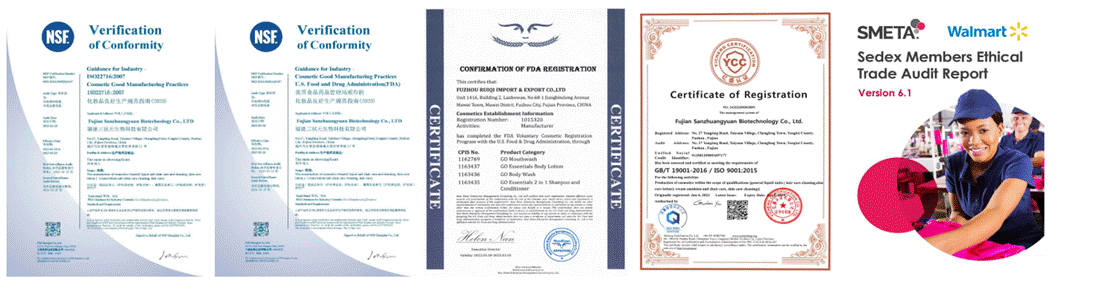
Ready to start that process?
Contact RuiqiGo, your certified personal care OEM manufacturer in China, to request our business credentials, review our GMP/ISO certifications, or schedule your directed virtual factory tour.