Most new shampoo product briefs we receive today already specify sulfate-free as a basic requirement.
Because of this widespread adoption, it is now the baseline expectation for any new hair care brand entering the market. Now, to build a product that generates repeat orders, you have to be intentional about the formulation.
You need to know how your surfactant base performs and how ingredients behave during production to make the right sourcing and formulation choices. This article covers the specific decisions you can make to help your product stand out.
Which Consumer Segments Are Driving the Demand for Sulfate-Free Shampoos?
Manufacturing orders do not come from broad markets. They come from specific buyer groups with specific hair and scalp needs.
Each batch run must be tailored to specific technical parameters depending on how the shampoo needs to perform. Based on production and market demands, these are the most popular formulations:
Scalp Health Formulations
Buyers in this category experience skin irritation and redness very easily. They require a gentle wash that cleanses the hair without triggering a painful or dry reaction on the skin barrier.
When you review your initial bench samples, you will see raw materials like sodium cocoyl isethionate rather than aggressive traditional cleansers. The factory’s goal is to prioritize skin compatibility over high foam volume.
Color Care and Post Treatment Formulations
This consumer group spends significant time and money on professional salon dyes and chemical straighteners.
Your product brief must specify gentle secondary surfactants that maintain the structural integrity of the hair shaft. Manufacturers evaluate these batches by measuring color retention over consecutive wash cycles.
Textured and Curly Hair Formulations
This category requires high viscosity and exceptional lubrication during the rinse phase to prevent hair breakage.
These components are paired with heavy conditioning agents that undergo high shear mixing to prevent the emulsion from separating in the storage tank. The target is a low stripping formula that maintains natural moisture levels.
How To Differentiate Your Product Beyond the Surfactant Base
Once you choose your primary surfactant base, you need to look at the supporting raw materials to set your product apart. When you submit your formula brief, your contract manufacturer will modify the base recipe using secondary additives.
These three directions are currently driving sulfate-free shampoo formulation:
Plant-Derived Proteins
Buyers with heat-damaged or chemically processed hair need instant smoothing during the wash process. To meet this requirement, the laboratory adds hydrolyzed proteins from quinoa or rice into the tank.
These raw materials coat damaged areas of the hair during application, providing a measurable performance boost that the production team can verify via standard wet combing tests.
Adding these proteins gives your product a functional performance mechanism that your production team can verify through standard wet combing tests.
Skin Care Ingredients for the Scalp
A growing number of consumers want products that actively address issues like dryness, excess sebum, or flaking while they wash.
The factory will add active ingredients like niacinamide and salicylic acid into shampoo tanks. You can also incorporate fermented botanical extracts to target these specific topical scalp concerns. The laboratory verifies that these additives do not lower the viscosity or ruin the clarity of your liquid.
Lightweight Plant-Based Alternatives to Silicone
Many buyers now avoid traditional heavy silicones because they cause long-term buildup and weigh down fine hair strands.
To meet this demand, sourcing requirements frequently specify a completely silicone-free formulation. You can replace standard dimethicone with plant-derived alternatives like volatile esters and specialized seed oils.
An organic shampoo manufacturer should be able to advise on which alternatives are stable within your specific base.
What Should You Expect from a Sulfate-Free Formulation?
Alternative cleansers behave differently during production compared to conventional surfactant systems. Knowing what to look for when you receive samples prevents back-and-forth that extends your development timeline.
When reviewing your pilot batches, you must carefully evaluate three critical performance factors:
Managing the Lather and Foam Profile
Sulfate-free bases do not build flash foam or density the same way traditional chemistries do. To test this sample, work the liquid with water between your hands to observe how fast the bubbles build and how long they hold their structure.
If the foam collapses instantly, the chemist needs to adjust the secondary co-surfactants like cocamidopropyl betaine. You are looking for a dense, creamy slip during the hand wash rather than a thin, watery bubble layer that disappears before you can even rinse.
Clarity vs. Cloudiness
Achieving a transparent liquid versus an opaque cream requires entirely different thickening mechanisms during the batching process. Hold your plastic bench sample up to direct light to inspect the bulk liquid for haze, micro-bubbles, or sediment settling at the bottom.
If you require a crystal-clear look, remember that the factory has a narrower choice of natural thickeners, which makes adjusting the final viscosity much harder. Opting for a pearlescent or opaque formula gives the manufacturer more flexibility to use natural gums without risking a hazy batch.
Formula Stability During Shipping
Plant-derived raw materials exhibit higher temperature sensitivity inside storage drums and shipping containers than petrochemical alternatives. Before you sign off on a full production run, explicitly ask your manufacturer for the laboratory’s freeze-thaw test documentation.
You can also run a simple check yourself by placing a sample jar in a standard refrigerator for 48 hours, then letting it thaw at room temperature. If the liquid separates into layers, thins out completely, or permanently clouds over, the emulsion base is unstable and will fail during transit.
What MOQ Should You Expect for Private Label Sulfate-Free Shampoo?
MOQ varies depending on whether the project uses a stock private label base or a fully customized formulation. Private label projects may start at lower quantities, while custom formulations generally require higher production minimums because the factory has to source and blend raw materials from scratch.
Because a stock project uses a pre-developed base already owned by the shampoo manufacturer, the production bypasses certain raw material minimums. However, your final order size will still fluctuate based on four specific manufacturing mechanics:
Master Batch Splitting
To offer low minimums, the factory fills a massive master mixing vessel with their pre-stabilized, sulfate-free stock formula. They then split this bulk liquid across multiple smaller client orders.
While conventional sulfate formulas are so cheap to run that factories keep them constantly flowing through filling lines, private-label sulfate-free bases must be batched in dedicated, scheduled cycles.
Customization Limits on Small Runs
While you can add custom scents or active ingredients to your portion of the master batch, your options are limited at lower MOQs. Sulfate-free bases are chemically fragile, so you cannot just stir in any oil without risking emulsion failure.
If you want a highly customized active stack, the manufacturer will require you to scale up your order to a full custom batch to justify the stability testing.
Stock Packaging vs. Custom Component MOQs
Even if the factory grants you a low minimum on the liquid shampoo, automated filling and capping machinery requires standardized physical containers. Using the factory’s in-stock, pre-verified bottles and caps may allow the project to use the applicable standard commercial MOQ, subject to final formula and packaging review.
If you bring in custom components, like a custom-colored pump closure, the packaging manufacturer’s separate tooling limits will dictate your actual upfront investment.
Line Clearance Fees for Fragrance Splits
If you want to split a private label order into two different scents, the filling lines must undergo a full wash-down and sanitation cycle between runs to prevent cross-contamination. Each fragrance variation requires its own separate mechanical setup.
If your individual runs are too small to justify that machine downtime, the factory will either raise the MOQ or charge an additional line clearance fee.
How Much Does it Cost to Start a Private Label Sulfate-Free Shampoo Brand?
Production cost varies significantly depending on formula complexity, packaging selection, order volume, and target market requirements. For this reason, a contract shampoo manufacturer provides pricing only after reviewing the final product brief.
Your per-unit pricing reflects three distinct factory cost centers:
- Premium Plant Cleansers: Replacing cheap, commodity SLS requires blending multiple specialized, mild surfactants. These alternative raw materials carry a significantly higher cost per kilogram.
- Specialty Thickeners: Basic table salt cannot build viscosity in sulfate-free systems. Compounding teams must use premium natural gums or liquid polymers to achieve a luxury, pourable texture.
- Slower Batch Cycles: Alternative bases trap air easily. To avoid filling tanks with foam, mixing speeds must be cut in half, doubling total tank residency time and increasing machine labor fees.

The Sulfate-Free Claims Trap: What Your Manufacturer Might Not Tell You
Absolute “100% sulfate-free” packaging claims carry high regulatory risk. Raw plant extracts often harbor trace sulfur elements that trigger audit failures. Protect your inventory by verifying your text across three compliance factors:
1. Trace Contamination Risks
Alternative surfactants often carry trace sulfur derivatives from processing. If tested, an absolute claim fails if trace elements register in parts per million (ppm). Always check the Certificate of Analysis (CoA) from your sulfate-free shampoo manufacturer to verify bulk purity before printing.
2. Defensible Packaging Language
Use qualified language that bypasses zero-trace verification. Phrasing like “free from harsh sulfates” accurately highlights the exclusion of aggressive SLS/SLES. Descriptors like “color-safe” or “gentle-cleansing” successfully turn the focus onto testable laboratory performance metrics.
3. Regulatory Dossier Vetting
Your partner must provide compliance guidance matching FDA and EU cosmetic regulations. Review the stock formula’s technical dossier against your planned packaging copy. If the factory lacks the compliance documentation or expertise to review claims, they are a high-risk partner.
How to Choose a Sulfate-Free Shampoo Manufacturer
Once you have dialed in your target MOQ and nailed down your packaging claims, you need to select the actual facility that will blend your liquid. A pristine sample means nothing if the production process cannot replicate it consistently in a massive mixing vessel.
When vetting potential private label partners, use these four checks to verify whether a manufacturer can consistently reproduce your approved formula:
1. Verification of Compliance Frameworks
Do not just accept a generic GMP-compliant logo on a sales brochure. Request a physical copy of the manufacturer’s current ISO 22716 or cGMP (Current Good Manufacturing Practice) certification.
When you receive the document, cross-reference the expiration date and ensure the facility address listed on the certificate matches the actual compounding and filling site where your shampoo will be produced, not just a corporate sales office.
2. Auditing Sulfate-Free Formulation Experience
Working with mild plant-derived surfactants requires a different level of chemistry than basic, salt-thickened sulfate formulas. Ask the supplier to send you retain samples of sulfate-free shampoos they manufactured 6 to 12 months ago for other brands.
Inspect these older bottles for cloudiness, sedimentation, or thinning. If a base has separated or lost its viscosity over time, it proves their stock formulation lacks long-term emulsion stability.
3. Reviewing In-House Stability Protocols
To ensure your product survives the supply chain, ask them to show you a blank copy of their standard Stability Report. A reliable manufacturer should perform these tests in-house rather than outsourcing them.
Verify that their protocol includes a 12-week high-temperature oven challenge (40℃ or 104℉), UV light exposure testing, and at least three freeze-thaw cycles. If they outsource this vetting, it will add 4 to 6 weeks to your launch timeline and introduce unexpected third-party fees.
4. Vetting the Scale-Up Protocol
A private label base that behaves perfectly in a small 5-kilogram laboratory beaker can easily thin out, shear, or trap permanent micro-bubbles when multiplied into a 2,000-kilogram industrial tank. Ask the production manager directly for their documented scale-up protocol.
A seasoned shampoo manufacturer will run a mandatory mid-sized pilot batch (around 100 to 200 kilograms) to calibrate the mixing speeds and cooling times before committing your formula to a full-scale commercial run.
Frequently Asked Questions About Sulfate-Free Shampoo Development
What is the standard MOQ for a custom sulfate-free shampoo?
It varies per manufacturer depending on formula complexity, packaging selection, and raw material requirements. Most manufacturers start at higher production minimums for custom runs. Pilot options may be available at lower quantities but typically carry a higher per-unit cost.
How long do the research, development, and stability testing phases take?
A standard development cycle runs 8 to 16 weeks from product brief approval to a stable, approved formula. Stability testing alone requires a minimum of 8 to 12 weeks under accelerated conditions.
Can one standard sulfate-free base handle different types of fragrances and essential oils?
Not always. Certain essential oils, particularly citrus and some florals, can destabilize emulsions or shift pH. Each fragrance variation should go through compatibility testing before it enters a production batch.
Why does my shampoo look cloudy or thick when left in cold shipping trucks?
Most natural thickening systems are temperature-sensitive. Cold temperatures cause gums and certain polymers to contract and change viscosity. This is a physical change, not a contamination issue, but it needs to be addressed in the formula specification and communicated clearly on product handling documentation.
Do alternative cleansers require a completely different preservative system?
Yes, in most cases. Mild surfactant systems have a different pH range and ionic environment than conventional shampoos, which affects how preservatives perform. A preservative system that works in a conventional formula may underperform in a sulfate-free base. Efficacy testing is required.
Can a sulfate-free shampoo also be made paraben-free, vegan, and silicone-free?
Yes. Combining these claims is common in current formulation briefs. Each additional restriction narrows the ingredient pool and may affect formula cost and stability, but it is achievable with an experienced formulation team.
Build Your Sulfate-Free Shampoo with Ruiqigo
As we have discussed, bringing a successful sulfate-free shampoo to market depends entirely on how well you navigate these core factory factors:
- Creating a rich, consumer-approved lather without over-stripping the hair fiber.
- Relying on natural gums and specialty polymers instead of cheap industrial salt.
- Vetting the formula through rigorous freeze-thaw testing to survive extreme shipping temperatures.
- Balancing liquid master batch splits against the separate tooling minimums of automated capping lines.
- Drafting qualified text that protects your inventory from strict FDA or EU regulatory audits.
However, managing all of these moving parts becomes much easier when you partner with a manufacturer who has executed the process over and over again.
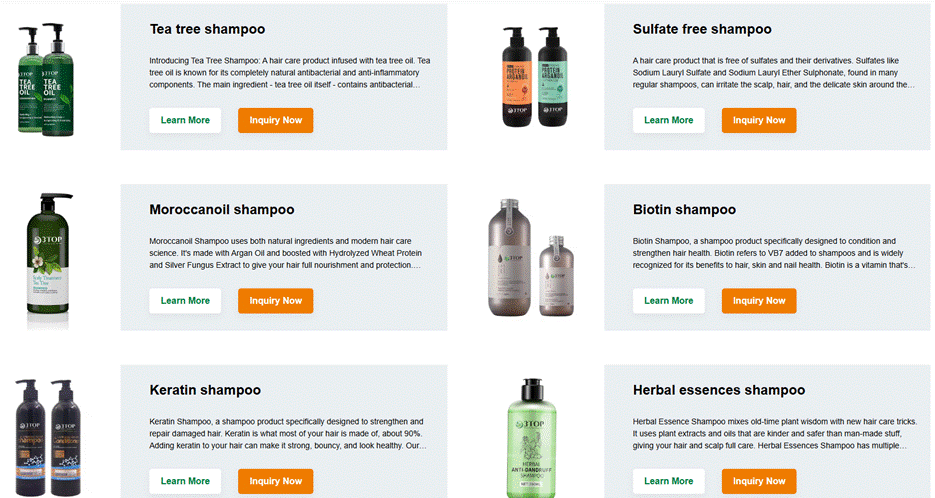
At Ruiqigo, we are an experienced OEM and private label shampoo manufacturer with a proven track record of developing mild, high-performing formulas for US buyers and Amazon FBA sellers. From running small-scale pilot batches to final commercial production, our team works directly with your formulation brief to deliver a successful product.
Are you ready to formulate a premium private-label sulfate-free shampoo?
Reach out to the Ruiqigo team today to start your development conversation.