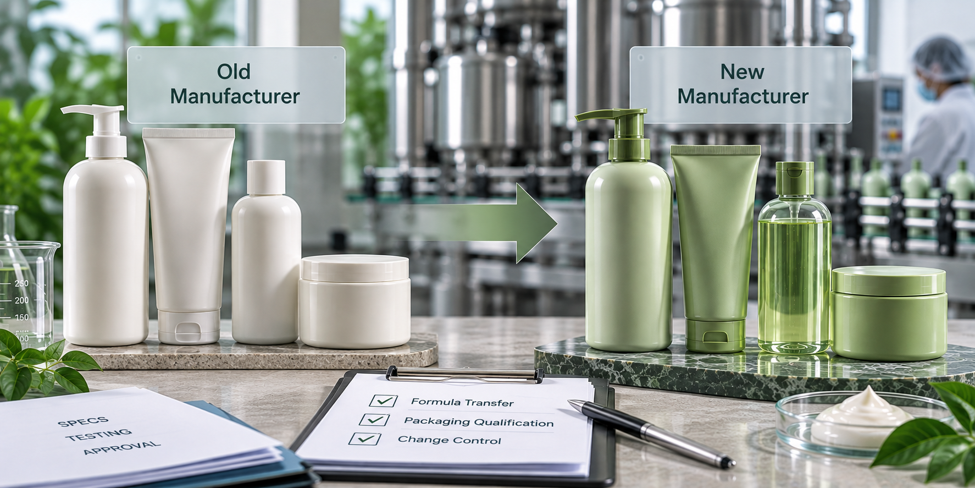
Changing manufacturers sounds simple until you have an existing product that already has a formula, packaging, specifications, and a production history behind it. You can’t simply send the new factory an ingredient list and expect everything to carry over exactly as it was.
What happens next depends largely on what you actually have from the current manufacturer. You may be able to transfer the formula directly, work from the finished product as a benchmark, or use the move as an opportunity to reformulate.
Switching personal care manufacturers is a technology-transfer and qualification process, and this guide covers how to switch cosmetic manufacturers the right way: how to determine the right path for your product, and what to have ready before the new manufacturer begins.
First Determine What You Actually Have
Before you start discussing the switch, take stock of the information you can get from the current manufacturer. The amount and quality of that information determines how the new manufacturer approaches the product, and changing cosmetic contract manufacturer without settling this first is the most common way a transfer stalls.
There are three common situations:
- Complete formula and manufacturing information available → Formula Transfer: The existing formula and relevant process information can be used as the basis for moving production to the new facility.
- Finished product or reference available, but the complete formula is not → Benchmark Matching: The new manufacturer works from the finished product and available specifications to match the required characteristics.
- Existing formula available, but you want to change the product → Reformulation: The formula becomes the starting point for intentional changes, such as adjusting cost, raw materials, performance, or regulatory requirements.
These pathways have different information requirements and different areas of uncertainty. Identifying the right one early helps set realistic expectations for what the new manufacturer can transfer, match, or change.
Formula Transfer: When the Original Formula and Process Information Are Available
Formula transfer is the most direct route when you have the original quantitative formula and the manufacturing information behind it. A cosmetic formula transfer to a new manufacturer should ideally include the quantitative formula, raw-material specifications, manufacturing process parameters, finished-product specifications, and QC/acceptance criteria.
Having the original information makes the transition more straightforward, but it doesn’t remove the need for validation. The same formula can behave differently when raw materials, equipment, batch size, process conditions, or the filling environment change, so the new manufacturer still needs to assess how the transferred formula performs in its own production environment before commercial manufacturing begins.
For example, In one project, the buyer provided the complete formula. The main transfer work involved sourcing and matching the required raw materials, followed by sample preparation to confirm the result.
Benchmark Matching: When the Finished Product Is Available but the Formula Is Not
Sometimes the original manufacturer won’t provide a complete formula, but you still have the finished product and know how it should look, feel, and perform. Useful information here includes a finished-product sample, whatever specifications are available, INCI information, performance expectations, and packaging details.
This is where benchmark matching cosmetic formula work differs from a direct formula transfer. The goal is to develop a product that meets the established reference criteria rather than assume the original manufacturing formula can be recovered.
Any gaps in the available reference should be identified before development begins so the target is clear and validation can be planned around it.
In this scenario, the available information didn’t establish exact formula percentages. Development proceeded by preparing and adjusting samples against the finished-product benchmark for evaluation.
Reformulation: When the Product Is Intentionally Being Changed
Reformulation is a different exercise from either of the above. It applies when the existing formula is the starting point for an intentional change, whether driven by raw-material availability, cost targets, performance goals, regulatory requirements, or a supplier change.
The question isn’t “can this be reproduced,” it’s “how does the intended change affect the product,” so the validation questions differ from a straightforward transfer.
Deciding between cosmetic reformulation vs benchmark matching comes down to intent: benchmark matching aims to reproduce what already exists as closely as possible, while reformulation deliberately sets out to change it.
An INCI List Is Not a Transferable Formula
An INCI list is the standardized ingredient list printed on a cosmetic product label. It tells you which ingredients are present and generally lists them in the order required for cosmetic labeling.
What it does not tell you is how much of each ingredient was used. It also does not identify the exact raw-material grade or supplier, the composition of compound raw materials, or the process used to turn those ingredients into the finished product.
Important manufacturing details such as addition sequence, mixing and homogenization conditions, processing temperature and time, and equipment parameters are also missing. These details can influence how the same nominal formula behaves at a different facility.
So, matching an existing formula from an INCI list should not be treated as recovering the original formula. The INCI can provide a useful starting point, but additional information or a finished-product reference is needed to determine how the product should be reproduced or matched.
Three-Pathway Decision Matrix
| Situation / Buyer Information | Formula Transfer | Benchmark Matching | Reformulation | Main Uncertainty | Validation Requirement |
| Complete quantitative formula + process information | Primary pathway | N/A | N/A | Transfer behaviour at the new facility | Process and product validation at the new facility |
| Finished product/reference but incomplete formula | N/A | Primary pathway | N/A | Reproducing the target characteristics | Benchmark evaluation and product validation |
| Existing formula but the buyer wants changes | N/A | N/A | Primary pathway | Effect of the intended changes | Reformulation and relevant product/stability validation |
| INCI list only | Not sufficient | Possible starting point | May be required | Unknown quantities, grades, and process | New development and validation required |
The matrix is a pathway guide, not a promise that every existing product can be reproduced exactly.
What Documents Should Be Ready Before a Manufacturer Switch?
Before you approach a new manufacturer, gather the technical information available from the existing production setup. Each document fills a different gap and helps the new team understand what needs to be transferred, checked, or developed again.
- Quantitative formula: Shows the exact percentage or quantity of each ingredient used in the product.
- Manufacturing process information: Describes how the formula is made, including relevant processing conditions, sequence, temperature, mixing, and homogenization.
- Raw-material specifications: Identifies the required characteristics of the materials used in the formula and helps the new manufacturer assess suitable sources or grades.
- Finished-product specifications: Defines the expected characteristics of the finished product, such as appearance, texture, pH, viscosity, or other applicable parameters.
- QC and acceptance criteria: Establishes the results a batch must meet to be accepted.
- Packaging specifications: Provides details about the existing container, closure, dimensions, materials, and other requirements needed to assess compatibility with the new filling line.
- Stability and testing records: Show what testing has already been performed and the results available for the existing product.
- Finished-product reference sample: Gives the new manufacturer a physical product to evaluate when the available formula or technical information is incomplete.
The COA (Certificate of Analysis), SDS (Safety Data Sheet), and manufacturing specifications are three documents that can easily be confused during a manufacturer transfer.
A COA provides batch-specific quality data against a specification, while an SDS covers hazard, handling, and storage information and is generally not batch-specific.
Neither replaces a manufacturing specification. They each provide part of the information needed for the transfer, but none tells the whole story on its own.
Having these materials together makes it easier to determine whether the project can follow Formula Transfer, Benchmark Matching, or Reformulation, and what additional validation may be needed.
Transfer-Readiness Checklist
Not every document carries the same weight in every manufacturer switch. What matters depends on whether you are transferring a known formula, matching an existing product, or intentionally changing it.
| Document / Information | Formula Transfer | Benchmark Matching | Reformulation |
| Quantitative formula | Required | Useful if Available | Important if reformulating from the existing formula |
| Manufacturing/process parameters | Required | Useful if Available | Important |
| Raw-material specifications | Required | Important | Important |
| Finished-product specification | Required | Important | Important |
| QC/acceptance criteria | Required | Important | Important |
| Packaging drawings/specifications | Important | Important | Important |
| Stability/testing history | Important | Important | Project-Dependent |
| Reference sample | Useful if Available | Required | Useful if Available |
| COA | Useful if Available | Useful if Available | Useful if Available |
| SDS | Useful if Available | Useful if Available | Useful if Available |
The labels are pathway-specific because the same document does not have the same importance in every project. For example, a complete quantitative formula is fundamental to Formula Transfer, while Benchmark Matching can proceed without it because the finished product serves as the primary reference.
What Happens When the Same Formula Moves to a New Factory?
Having the same formula on paper doesn’t guarantee it behaves the same way at another facility. This is the core of cosmetic manufacturer transfer risk.
RuiqiGO has confirmed that a transferred formula’s behaviour can shift because of raw-material supplier or grade changes, differences in compound-material composition, equipment or shear differences, batch size, heating and cooling conditions, and addition sequence.
The aim is to confirm that the formula and process work together under the new production conditions, rather than assuming the written formula tells the whole story.
Raw-Material Substitution Requires More Than an INCI Match
A raw-material change can look minor on paper but still affect the transferred product. Two materials can share the same INCI name without being identical in grade, source, or technical characteristics. It helps to distinguish between:
- Same material, same specification: The closest situation to the original material.
- Same material, different supplier or site: The INCI may remain the same, but the material’s characteristics can differ.
- Different grade: The ingredient may have the same INCI but a different grade that changes how it performs.
- Alternative material with a matching INCI: The ingredient name may look the same on the label even though the material itself is different.
- Formula adjustment: If the available substitute does not behave sufficiently like the original, the formula may need to be adjusted.
This is why cosmetic change control raw material decisions should be based on the potential effect of the substitution, not simply whether the INCI name matches.
When a Transfer Carries Higher Risk
Some situations increase risk before a project even reaches validation: no usable reference sample or target criteria, key raw materials or packaging that can’t be identified or sourced, a request to move straight to commercial production without necessary validation, unclear quality or acceptance criteria, and requested materials that don’t meet applicable regulatory requirements.
This doesn’t mean every INCI-only project is turned away. An INCI-only project can’t be treated as a direct formula transfer, but depending on the available reference and requirements, it may still proceed as benchmark matching or new development.
Does Packaging Need to Be Requalified When Changing Manufacturers?
Packaging approval doesn’t automatically carry over to a new production environment. RuiqiGO has confirmed that an already-qualified package generally needs to be reconsidered against the new equipment and filling line, particularly for filling behaviour and line-speed/equipment compatibility.
Beyond that, other factors commonly discussed in packaging requalification new filling line contexts, such as nozzle or filling-method differences, capping or torque equipment, and setup tolerances, can also matter, though which apply depends on the specific transfer rather than forming one fixed checklist.
The question isn’t whether the package looks the same on paper; it’s whether it performs correctly on the new manufacturing environment and filling line. This review considers the same factors covered when assessing personal care packaging compatibility, but the focus here is specifically on what changes when production moves to a different facility.
Validation Before Commercial Production
Validation scope depends on which pathway applies and what’s changed. This can include checking product specifications, process performance, raw-material equivalence, packaging and filling-line performance, finished-product quality, and stability or other testing where relevant. There’s no single validation package that applies to every manufacturer switch.
Change Control After the Transfer
A successful transfer isn’t the end of the process. Keep a review process for changes such as raw-material supplier or grade, formula, process parameters, equipment, packaging components, and filling-line setup. The key question each time is whether the change could affect the product or manufacturing configuration that was previously validated.
Working With a New Personal Care Manufacturer
When you approach a new OEM/ODM/private-label manufacturer with an existing commercial product, the manufacturer should first understand what information you have, which of the three pathways applies, what can be transferred directly, what needs benchmark matching, what requires reformulation, and what validation still remains.
RuiqiGO supports this transition as the manufacturer for the product itself. Where packaging is involved, RuiqiGO provides guidance on suitable packaging and coordinates with packaging suppliers, rather than manufacturing the packaging directly.
For personal care manufacturing support, our private-label service, and how information is verified through quality control, each plays a role in a switch, but the switching process itself is what this guide is about, not a general service overview.
Questions to Ask Before Switching Manufacturers
A few questions can reveal what the transition will actually involve, before development or sampling begins:
- Do you have the complete quantitative formula?
- Do you have the original manufacturing/process information?
- Do you have a finished-product reference sample?
- Which product specifications and acceptance criteria are available?
- What packaging information is available?
- What stability/testing history can be transferred?
- Are any raw materials likely to require substitution?
- Will the product move to a different filling line?
- What changes are expected during the transition?
- Which pathway, transfer, benchmark matching, or reformulation, fits the project?
These questions give the new manufacturer a clearer starting point and help uncover potential transfer issues before they become production problems.
FAQs
How Do You Switch a Personal Care Manufacturer?
Start by gathering the formula, manufacturing information, product specifications, packaging details, testing records, and a finished-product reference where available. The new manufacturer can then determine whether the project is best handled through Formula Transfer, Benchmark Matching, or Reformulation. From there, the relevant materials, process conditions, packaging setup, and validation requirements can be reviewed before commercial production.
Can a Manufacturer Reproduce a Product From an INCI List?
No. An INCI list doesn’t contain the quantitative and process information needed to reproduce the original formula exactly; at best it supports an estimated starting point.
What If I Don’t Have My Original Cosmetic Formula?
You may need benchmark matching based on the finished product or reference, or reformulation, depending on the project and what’s available.
What Is the Difference Between Formula Transfer and Benchmark Matching?
Formula transfer uses a sufficiently complete existing formula and process specification. Benchmark matching works toward the target characteristics of an existing product when the full formula isn’t available.
Can the Same Cosmetic Formula Behave Differently at Another Factory?
Yes. Raw materials, equipment, batch size, and process conditions can all influence the result, even with identical documentation. The filling environment can also introduce differences. That is why a transferred formula needs to be evaluated under the new facility’s production conditions.
Does Changing Manufacturers Require New Stability Testing?
Not automatically. It depends on what changes during the transfer and what validation evidence is already available. It isn’t automatically required for every switch.
Does Packaging Need to Be Retested When Changing Manufacturers?
It may need requalification or additional evaluation. A new facility or filling line can change how the package performs even when the formula and package specifications remain unchanged. The appropriate level of reassessment depends on the specific manufacturing environment and what has changed.
Switch Manufacturers Without Treating the Transfer as a Simple Handover
Switching manufacturers is more than moving an existing formula from one factory to another. The right pathway depends on what information you have and what you need the new manufacturer to achieve.
Start with Formula Transfer, Benchmark Matching, or Reformulation, then work through the gaps in the available formula, raw materials, process, packaging, and validation requirements. This makes it easier to identify issues before they reach commercial production.
Switching from an existing personal care manufacturer?
Contact RuiqiGO’s manufacturing team to discuss your product, available formula and manufacturing documentation, production requirements, and transition goals.
Our team can assess which pathway fits your project and provide guidance on packaging requirements, including coordination with suitable packaging suppliers where needed.