A body wash that appears bright under a UV lamp can raise questions about its ingredients, but a visual glow is not a complete identification test or a safety assessment. For a commercial buyer, the useful next step is a controlled quality investigation. This article explains what to document and how to avoid drawing conclusions that the observation cannot support.
Separate observation from identification
Record exactly what was observed: the lamp used, the sample, the container, the lighting conditions and any comparison material. Do not label the observation as a specific fluorescent brightener unless an appropriate analytical method supports that identification. A photograph taken under an unspecified lamp does not establish the substance, its concentration or why it is present.
Use comparable measurement conditions
Compare samples under a documented procedure, including suitable blanks and the same containers and viewing conditions. Ask a qualified laboratory to define the method when a meaningful ingredient or contamination question remains. NIST explains that spectral fluorescence measurements are affected by instrument characteristics and interactions with the sample and its environment; this is a reason to control the measurement, not to treat every visible glow as equivalent.
Review the ingredient and batch records
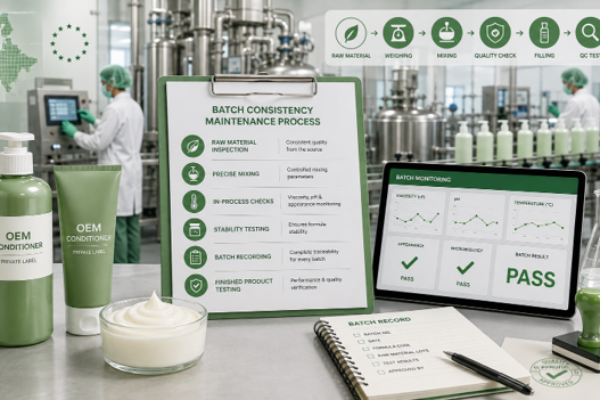
Check the approved formula version, ingredient identities, supplier specifications, batch references and any recent changes. Clarify whether the concern concerns the bulk product, package, label or a possible contaminant. Keep a retained sample and document the handling history where available. A vague fluorine-free or fluorescents-free marketing statement is not a substitute for a defined specification.
Do not transfer detergent conclusions to cosmetics
Information about a substance in laundry products does not by itself establish acceptability in a cosmetic body wash. Intended use, ingredient identity, concentration, finished formulation and target market all matter. The article does not approve any fluorescent brightener for cosmetic use. Product-specific ingredient and claims review is needed before a brand makes a safety or compliance statement.
Keep safety substantiation separate
A UV check cannot replace review of the finished product, its ingredients, preservation, intended use and relevant supporting evidence. FDA product-testing guidance describes the use of available ingredient and formulation data together with additional testing where needed. A pass or fail decision should refer to an agreed specification and a suitable method, with qualified review of any finding.
Prepare a focused OEM quality enquiry
Established brands, importers and distributors should provide the target market, formula or INCI information, sample identification, packaging and the exact quality question. RuiqiGO can review the manufacturing brief and clarify the required technical evaluation scope. For procurement and standard commercial quantities, use the body wash manufacturing page; this article addresses the limits of the visual screening question.
For commercial project review, visit body wash manufacturing or share your approved product brief.
Reference: FDA: Product Testing of Cosmetics · NIST: Spectral Fluorescence Measurements.