
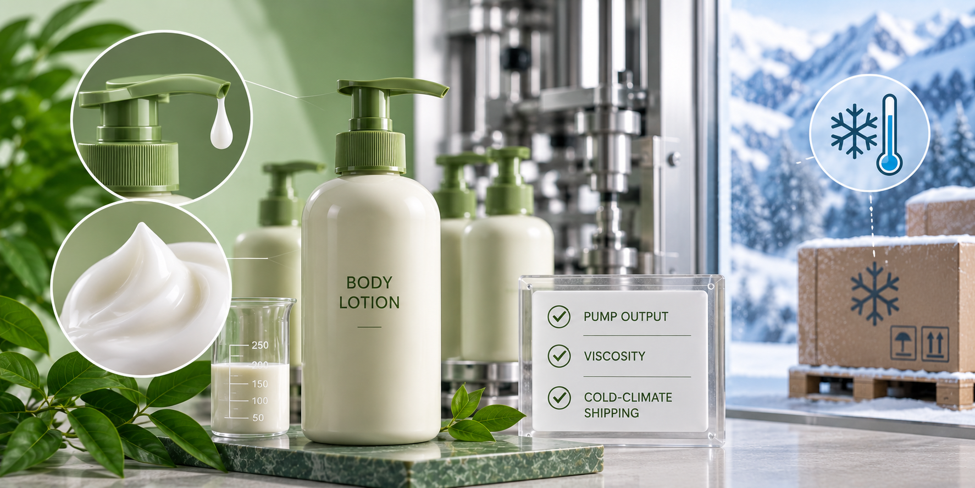
A body lotion may dispense smoothly during development, only to become noticeably harder to pump after being exposed to cold temperatures. The product may become thicker, the pump may struggle to prime, and the amount delivered with each press may change.
That becomes especially relevant when the lotion will be stored or transported through colder conditions. What works at room temperature may not give you the same dispensing performance once the temperature drops.
This guide looks at how body lotion viscosity cold temperature effects can influence dispensing and packaging performance, and how to distinguish low-temperature performance from freeze-thaw stability.
How Cold Temperatures Change Body Lotion Behaviour
A drop in temperature can affect how easily a body lotion moves. As the temperature gets lower, a lotion may become thicker and more resistant to flow than it is at room temperature.
That change can become noticeable once the lotion has to move through the dispensing system. The pump draws product up through the dip tube and into the dispensing pathway, so a thicker lotion may require more effort to move through those parts, affecting priming speed, delivered amount, and how easily product is picked up from the bottle.
RuiqiGO has observed these effects under winter conditions of approximately 0 to 5°C, including increased viscosity and poorer flow, difficulty with pump priming or dispensing, changes in delivered amount, and difficulty picking up the lotion through the dip tube.
Pump geometry and dip-tube dimensions can influence how easily the lotion moves at a given temperature, which is why performance at room temperature does not necessarily predict what happens in colder conditions.
Why a Lotion Can Become Harder to Dispense in Cold Conditions
Body lotion pump cold weather problems tend to show up as one or more distinct symptoms, not a single failure:
- Slower product flow through the dip tube and dispensing pathway as viscosity increases.
- Pump priming difficulty: a pump that primes reliably at room temperature may need extra strokes, or fail to prime, once the formula thickens.
- Inconsistent dosage: the amount delivered per press can vary stroke to stroke.
- Increased flow resistance: the user has to press harder for the same result, affecting perceived quality even when the formula hasn’t changed.
Body lotion pump priming failure at low temperature is rarely traceable to one cause. Pump geometry, dip-tube dimensions and dispensing-path characteristics can interact with the formula under colder conditions, which is why the formula and package need to be evaluated together rather than assuming nominal pump output holds at every temperature.
Check Pump, Dip Tube and Dosage Performance at the Intended Temperature
The temperature your lotion is expected to encounter depends on where and how it will be sold.
Start with the actual route and expected exposure: destination, season, storage environment, transport conditions, and how long the product may remain in those conditions. That determines which temperature range should be considered when assessing the dispensing system.
At that temperature, check whether the pump primes reliably, picks up the lotion through the dip tube, and delivers a reasonably consistent amount. These checks are more useful performed with the actual lotion rather than water or the pump’s stated dosage.
This is particularly relevant for body lotion pump dosage testing and body lotion dip tube cold temperature behaviour. The amount printed in a pump specification describes the component, but the result you get from the finished product depends on the pump, dip tube, lotion, and the conditions under which it’s dispensed.
Assess the Package’s Structural Performance Under Temperature Exposure
The dispensing system is only part of the package; the bottle and closure can also be relevant considerations when assessing performance under the temperature conditions the product is expected to encounter.
Consider how the assembled package may perform under the relevant temperature exposure. Bottle shape retention, closure fit, and sealing performance can all be considered when evaluating whether the package remains suitable for storage and transport conditions.
If the bottle develops inward dents or collapsed sections, sometimes called paneling, don’t automatically assume cold temperature caused the deformation. Paneling can occur when the pressure inside the bottle becomes lower than the pressure outside it, so the surrounding conditions need to be considered rather than assumed.
For lotion bottle panel deformation cold cases specifically, the important question is what actually caused the change in shape, not just what temperature it was exposed to.
Sealing and leakage are also relevant evaluation considerations, since temperature exposure can affect how an assembled package performs under the conditions relevant to the intended storage or transport route.
Cold-Temperature Dispensing vs. Freeze-Thaw Stability
Cold exposure does not always mean that a body lotion has frozen. A lotion can remain liquid while becoming thicker and harder to dispense, which creates a different concern from what happens when the product actually freezes and thaws.
The two evaluations therefore answer different questions:
- Cold-temperature evaluation: Can the lotion still be dispensed properly at the low temperatures it is expected to encounter? This includes checking pump priming, delivered amount, dip-tube pickup, and general package performance.
- Freeze-thaw evaluation: What happens to the lotion and package when they go through repeated freezing and thawing? This can reveal changes to the lotion’s stability, appearance, viscosity, or the package itself.
The exact conditions and evaluation method remain project-dependent. They should be considered in relation to the formula, packaging configuration, intended storage conditions, transport route, and temperatures the product is expected to encounter.
The relevant evaluation depends on where the lotion is going and what conditions it is likely to experience. A product stored in a cold warehouse may need to be assessed differently from one that could be exposed to temperatures below freezing during transport.
Consider the formula’s temperature tolerance, intended storage conditions, transport route, transport duration, and seasonal exposure. These details help determine whether low-temperature dispensing, freeze-thaw exposure, or both should be considered.
There is no single testing package that applies to every body lotion. The evaluation should reflect the product’s characteristics and the conditions it is expected to encounter.
Does Body Lotion Need Cold-Chain Shipping?
A lotion sold in a cold market doesn’t automatically need refrigerated shipping; the decision depends on how well the formula tolerates the temperatures it’s likely to encounter during storage and transport.
Start by looking at the actual distribution conditions: how cold is the product expected to get, how long might it remain at those temperatures, and will it sit in a warehouse, cross regions, or face changing temperatures along the route? These questions separate three different approaches:
- Avoiding damaging exposure: keeping the product within a suitable temperature range may be enough if the route allows it.
- Validating cold-temperature performance: if the product will encounter cold conditions, formula and packaging can be evaluated under those conditions.
- Using refrigerated transport: appropriate when temperature requirements and route call for tighter control.
So, body lotion cold chain shipping should be decided from the product’s demonstrated temperature tolerance and actual distribution conditions, not treated as a standard requirement for every lotion sold in a cold climate.
Validate Body Lotion Packaging for the Actual Transport Route
“Cold climate” can describe very different conditions. A lotion may spend a few hours in transit at a low temperature, sit in storage for several days, or experience repeated temperature changes as it moves through different locations.
That makes the distribution route a useful starting point for deciding what needs to be evaluated:
- Destination market: where will the lotion be sold?
- Seasonal conditions: what temperatures are likely during distribution?
- Storage: where will the product be kept before and after transport?
- Transport duration: how long could the lotion remain exposed to relevant temperatures?
- Package configuration: what bottle, closure, pump, and dip tube will be used?
- Formula behaviour: how does the actual lotion respond under those conditions?
From there, the relevant checks can be defined around the route rather than a generic idea of “cold weather,” which may include body lotion transport temperature testing for the expected conditions, along with checks on dispensing and package integrity where appropriate.
For a broader look at how formula and packaging should be considered together, see our guide to personal care packaging compatibility.
What to Confirm Before Commercial Production
Before production begins, bring the relevant findings together and confirm the intended setup has been considered under the conditions it’s expected to face: formula behaviour, pump priming and dosage, dip-tube performance, bottle and closure integrity, leakage, and relevant temperature exposure.
It’s also worth deciding whether freeze-thaw evaluation is relevant to the actual route, since not every body lotion needs the same temperature evaluation.
Body Lotion Cold-Climate Packaging Risk Matrix
Use the matrix below to connect the temperature conditions a lotion may encounter with changes in the formula, dispensing system, and package.
| Condition / Stressor | What May Change in the Formula | What May Change in the Dispensing/Package System | What to Evaluate | When Relevant |
| Low-temperature storage | Viscosity, rheology, and flow behaviour may change | Pump priming, dosage, dip-tube flow, and dispensing behaviour may change | Actual formula/package performance at the relevant temperature | When the product will encounter low storage temperatures |
| Cold transport | Temperature-related changes may affect flow | Dispensing, sealing, leakage, or structural performance may change | Performance under the expected transport conditions | When the distribution route exposes the product to cold conditions |
| Freeze-thaw cycling | Emulsion stability, appearance, viscosity, or other formula characteristics may change | Cracking, distortion, or other package compatibility issues may occur | Formula and package response through the relevant freeze-thaw exposure | When the intended route or product risk makes freeze-thaw exposure relevant |
| Temperature variation | Formula behaviour may vary across the expected temperature range | Dispensing and package performance may vary | Performance across the relevant temperature range | When the product experiences meaningful temperature variation during distribution |
This matrix isn’t a universal testing protocol. It helps you identify which temperature-related risks are relevant to your product and distribution route, and what part of the formula or package should be evaluated in response.
When Should Cold-Climate Packaging Be Re-evaluated?
A packaging setup may have performed well under the original conditions, but that assessment only applies to the configuration actually evaluated. If something changes later, the effect on cold-weather performance should be considered before moving ahead with the new setup.
Changes worth reviewing include:
- Formula: A change in viscosity or rheology can alter how the lotion behaves at low temperatures.
- Pump or dip tube: A different component can change priming, product pickup, or dosage.
- Bottle or closure: A new container or closure can affect fit, sealing, or structural performance.
- Sealing components: A different gasket may change leakage performance.
- Packaging supplier: A new supplier can introduce differences in the component used.
- Distribution route: A new market, season, or expected temperature range can expose the product to different conditions.
The key question is whether the change could affect the formula, package, and temperature combination previously evaluated, and if so, whether that calls for additional evaluation or retesting.
Working With a Manufacturer on Cold-Climate Packaging Validation
A packaging component can look suitable on paper and still need closer evaluation once paired with the actual lotion. The useful discussion with your manufacturer is about how the complete setup performs, not whether a pump or bottle is commonly used for body lotion.
Start by discussing the packaging you plan to use and performance requirements important to the finished product, such as dispensing amount, easy pump actuation, reliable product pickup, or consistent performance after exposure to lower temperatures.
Ask what has actually been evaluated
Find out whether the assessment covered the actual lotion, the dispensing components, and the relevant temperature conditions. That clarifies what the results actually tell you, and what may still need evaluation before adopting the setup for commercial production.
Bring changes back into the conversation
If you later change the formula, pump, dip tube, bottle, closure, sealing component, or supplier, discuss it with your manufacturer before moving ahead, since a new component or formula can alter the conditions the original evaluation was based on.
These conversations apply whether you’re working with a body lotion manufacturer on this product or a broader body care manufacturer across a wider range, since packaging decisions are easier to evaluate when temperature exposure and route are part of the conversation from the start.
Frequently Asked Questions
What is the difference between freeze-thaw and cold-temperature testing?
Cold-temperature testing looks at how the lotion and package perform at low temperatures, including dispensing and pump performance. Freeze-thaw testing looks at what happens when the product freezes and thaws; the two address different risks and aren’t interchangeable.
Does a cosmetic product need freeze-thaw testing for shipping?
Not necessarily. It depends on the formula and the temperatures the product is likely to encounter during storage and transport.
How should body lotion be shipped in cold weather?
Start with the temperatures the product is likely to encounter, then consider destination, season, route, and duration of exposure. The shipping approach should follow those conditions; cold-chain shipping isn’t automatically required.
Should pump dosage be tested with the actual lotion formula?
Where pump-output performance is relevant, it should be evaluated with the actual lotion rather than inferred from the nominal component specification alone. The pump’s stated output does not guarantee the same dosage with every lotion, so testing the actual formula with the pump and dip tube under relevant temperature conditions can provide a more reliable result.
Can cold temperatures cause plastic bottles to deform?
Cold exposure can be part of the conditions surrounding deformation, but it shouldn’t automatically be considered the cause. Paneling occurs when sections of a bottle collapse inward because of a pressure difference between the inside and outside of the container.
Prepare Body Lotion Packaging for Real-World Cold Conditions
Cold-weather performance is easier to manage when considered before the packaging is finalized. The goal is to understand what the finished lotion is likely to encounter and make sure the chosen formula and package can handle those conditions.
That doesn’t mean every lotion needs the same tests or shipping arrangements: a product facing low temperatures may need dispensing assessed under those conditions, while one at risk of freezing may need a different type of evaluation.
If you are planning to launch a body lotion for a cold-climate market, contact RuiqiGO’s manufacturing team to discuss your formula, manufacturing requirements, and packaging needs.



-600x400-c.jpg)
